Moz Q&A is closed.
After more than 13 years, and tens of thousands of questions, Moz Q&A closed on 12th December 2024. Whilst we’re not completely removing the content - many posts will still be possible to view - we have locked both new posts and new replies. More details here.
Problems with WooCommerce Product Attribute Filter URL's
-
I am running a WordPress/WooCommerce site for a client, and Moz is picking up some issues with URL's generated from WooCommerce product attribute filters. For example:
..co.uk/womens-prescription-glasses/?filter_gender=mens&filter_style=full-rim&filter_shape=oval
How do I get Google to ignore these filters?
I am running Yoast Premium, but not sure if this can solve the issue? Product categories are canonicalised to the root category URL.Any suggestions very gratefully appreciated.
Thanks
Bob
-
You can tell Google what URL parameters to ignore in Google Search Console. It's under Crawl > URL Parameters > Configure URL Parameters. Google does advise to use caution when changing how Google bot handles the parameters.
-
If you got canonicals set up properly, not much else you can do. Google should recognize what you are trying to do but it will still crawl the filters.
If you don't want the subcategories indexed and crawls minimized:
- nofollow filter links
- block them via robots using wildcards
- set to noindex for all filtered urls.



Got a burning SEO question?
Subscribe to Moz Pro to gain full access to Q&A, answer questions, and ask your own.
Browse Questions
Explore more categories
-
Moz Tools
Chat with the community about the Moz tools.
-
SEO Tactics
Discuss the SEO process with fellow marketers
-
Community
Discuss industry events, jobs, and news!
-
Digital Marketing
Chat about tactics outside of SEO
-
Research & Trends
Dive into research and trends in the search industry.
-
Support
Connect on product support and feature requests.
Related Questions
-

What's the best way to handle product filter URLs?
I've been researching and can't find a clear cut answer. Imagine you have a product category page e.g. domain/jeans You've a lot of options as to how to filter the results domain/jeans?=ladies,skinny,pink,10 or domain/jeans/ladies-skinny-pink-10 or domain/jeans/ladies/skinny?=pink,10 And in this how do you handle titles, breadcrumbs etc. Is the a way you prefer to handle filters and why do you do it that way? I'm trying to make my mind up as some very big names handle this differently e.g. http://www.next.co.uk/shop/gender-women-category-jeans/colour-pink-fit-skinny-size-10r VS https://www.matalan.co.uk/womens/shop-by-category/jeans?utf8=✓&[facet_filter][meta.tertiary_category][Skinny]=on&[facet_filter][variants.meta.size][Size+10]=on&[facet_filter][meta.master_colour][Midwash]=on&[facet_filter][min_current_price][gte]=6.0&[facet_filter][min_current_price][lte]=18.0&per=36&sort=
Technical SEO | | RodneyRiley0 -

URL Structure On Site - Currently it's domain/product-name NOT domain/category/product name is this bad?
I have a eCommerce site and the site structure is domain/product-name rather than domain/product-category/product-name Do you think this will have a negative impact SEO Wise? I have seen that some of my individual product pages do get better rankings than my categories.
Technical SEO | | the-gate-films0 -

Does Title Tag location in a page's source code matter?
Currently our meta description is on line 8 for our page - http://www.paintball-online.com/Paintball-Guns-And-Markers-0Y.aspx
Technical SEO | | Istoresinc The title tag, however sits below a bunch of code on line 237
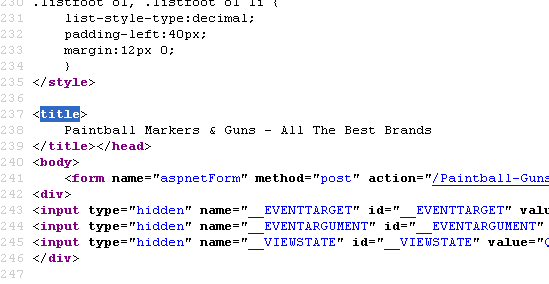 Does the location of the title tag, meta tags, and any structured data have any influence with respect to SEO and search engines? Put another way, could we benefit from moving the title tag up to the top?
I "surfed 'n surfed" and could not find any articles about this.
I would really appreciate any help on this as our site got decimated organically last May and we are looking for any help with SEO.
NIck
0
Does the location of the title tag, meta tags, and any structured data have any influence with respect to SEO and search engines? Put another way, could we benefit from moving the title tag up to the top?
I "surfed 'n surfed" and could not find any articles about this.
I would really appreciate any help on this as our site got decimated organically last May and we are looking for any help with SEO.
NIck
0 -

How to create site map for large site (ecommerce type) that has 1000's if not 100,000 of pages.
I know this is kind of a newbie question but I am having an amazing amount of trouble creating a sitemap for our site Bestride.com. We just did a complete redesign (look and feel, functionality, the works) and now I am trying to create a site map. Most of the generators I have used "break" after reaching some number of pages. I am at a loss as to how to create the sitemap. Any help would be greatly appreciated! Thanks
Technical SEO | | BestRide0 -

Are Collapsible DIV's SEO-Friendly?
When I have a long article about a single topic with sub-topics I can make it user friendlier when I limit the text and hide text just showing the next headlines, by using expandable-collapsible div's. My doubt is if Google is really able to read onclick textlinks (with javaScript) or if it could be "seen" as hidden text? I think I read in the SEOmoz Users Guide, that all javaScript "manipulated" contend will not be crawled. So from SEOmoz's Point of View I should better make use of old school named anchors and a side-navigation to jump to the sub-topics? (I had a similar question in my post before, but I did not use the perfect terms to describe what I really wanted. Also my text is not too long (<1000 Words) that I should use pagination with rel="next" and rel="prev" attributes.) THANKS for every answer 🙂
Technical SEO | | inlinear0 -

Best Practices for adding Dynamic URL's to XML Sitemap
Hi Guys, I'm working on an ecommerce website with all the product pages using dynamic URL's (we also have a few static pages but there is no issue with them). The products are updated on the site every couple of hours (because we sell out or the special offer expires) and as a result I keep seeing heaps of 404 errors in Google Webmaster tools and am trying to avoid this (if possible). I have already created an XML sitemap for the static pages and am now looking at incorporating the dynamic product pages but am not sure what is the best approach. The URL structure for the products are as follows: http://www.xyz.com/products/product1-is-really-cool
Technical SEO | | seekjobs
http://www.xyz.com/products/product2-is-even-cooler
http://www.xyz.com/products/product3-is-the-coolest Here are 2 approaches I was considering: 1. To just include the dynamic product URLS within the same sitemap as the static URLs using just the following http://www.xyz.com/products/ - This is so spiders have access to the folder the products are in and I don't have to create an automated sitemap for all product OR 2. Create a separate automated sitemap that updates when ever a product is updated and include the change frequency to be hourly - This is so spiders always have as close to be up to date sitemap when they crawl the sitemap I look forward to hearing your thoughts, opinions, suggestions and/or previous experiences with this. Thanks heaps, LW0 -

Trailing Slashes In Url use Canonical Url or 301 Redirect?
I was thinking of using 301 redirects for trailing slahes to no trailing slashes for my urls. EG: www.url.com/page1/ 301 redirect to www.url.com/page1 Already got a redirect for non-www to www already. Just wondering in my case would it be best to continue using htacces for the trailing slash redirect or just go with Canonical URLs?
Technical SEO | | upick-1623910 -

A question about RSS feeds and nofollow's
With the nofollow tag used very widely on the internet these days I was just wondering about how an RSS feed might help me find a way around it. Basically my question is this : I post a comment on a blog, it's approved and my comment together with my link(nofollow tag applied) is there. Now when the blogs RSS feed updates, does this nofollow tag get applied to the feed? As far as I can tell it does not - but I'm not too clue'd up on how the feed is generated. Anyone want to help me understand how it works and if what I'm suggesting would be 'a way around the nofollow tag' ? Thanks 🙂
Technical SEO | | DanHill0