Moz Q&A is closed.
After more than 13 years, and tens of thousands of questions, Moz Q&A closed on 12th December 2024. Whilst we’re not completely removing the content - many posts will still be possible to view - we have locked both new posts and new replies. More details here.
How to create site map for large site (ecommerce type) that has 1000's if not 100,000 of pages.
-
I know this is kind of a newbie question but I am having an amazing amount of trouble creating a sitemap for our site Bestride.com. We just did a complete redesign (look and feel, functionality, the works) and now I am trying to create a site map. Most of the generators I have used "break" after reaching some number of pages. I am at a loss as to how to create the sitemap. Any help would be greatly appreciated!
Thanks
-
I agree with Chris. With such large websites it would be advisable having a sitemap index and then splitting the index into various individual indexes such as Pages, Products, Categories, images, media, tags etc.
-
The easiest thing i can think of is to write a script that works with your dispatcher to create a site map. The format I would use is add the page and all of the "product images" on the page to the map and move to the next. At the same time I would use an auto increment variable to keep track of how many lines you have written. When you get around 50k, write out the name of the next site map file that the program will create and have them chained together this way.
-
That's a great help Chris, thank you! And thanks to all for your help!
-
Typically, a sitemap is going to include every page on the site. As Francesca said, each sitemap can be up to 50K urls and if you need multiple sitemaps then you create a sitemap index that points to the rest of the sitemaps.
-
Thanks for the feedback!
I will look into screamingfrog for sure.
@Lesley - we are using a custom platform (in house) so we don't have that functionality. The issue is that we have a lot of inventory (millions) of cars. We have built (and are releasing new functionality today) to provide internal links so that Google can crawl all the inventory easily (users can too :). My question about sitemaps has boiled down to this: Do we need to build the sitemap to include every single page (all the inventory) or do we provide a "map" so that google can find the top pages and then crawl the inventory from there. Again the site is bestride.com. If anyone wants to take a look at the site, that would be fantastic!
Thanks
-
Are you using a custom platform or an off the shelf e-commerce package? Most off the shelf packages actually have a module that can create a site map and a lot have it where you can cron it too.
-
Of course, you can also use the moz's crawl test report at http://pro.moz.rainyclouds.online/tools/crawl-test
-
Hi Kristin,
Each sitemap.xml can support maximum 50.000 URLs. So, If you have a site with more than 100K, It'd be better to create 2 or 3 o 4 etc sitemaps.xml in order to contain all URLs. Hope it is useful.
Kind regards!
Francesca
-
You can use screamingfrog to create your sitemap. You just need to license it for crawl more than 500 URI.





Got a burning SEO question?
Subscribe to Moz Pro to gain full access to Q&A, answer questions, and ask your own.
Browse Questions
Explore more categories
-
Moz Tools
Chat with the community about the Moz tools.
-
SEO Tactics
Discuss the SEO process with fellow marketers
-
Community
Discuss industry events, jobs, and news!
-
Digital Marketing
Chat about tactics outside of SEO
-
Research & Trends
Dive into research and trends in the search industry.
-
Support
Connect on product support and feature requests.
Related Questions
-

Sitemap.xml strategy for site with thousands of pages
I have a client that has a HUGE website with thousands of product pages. We don't currently have a sitemap.xml because it would take so much power to map the sitemap. I have thought about creating a sitemap for the key pages on the website - but didn't want to hurt the SEO on the thousands of product pages. If you have a sitemap.xml that only has some of the pages on your site - will it negatively impact the other pages, that Google has indexed - but are not listed on the sitemap.xml.
Technical SEO | | jerrico10 -

URL Structure On Site - Currently it's domain/product-name NOT domain/category/product name is this bad?
I have a eCommerce site and the site structure is domain/product-name rather than domain/product-category/product-name Do you think this will have a negative impact SEO Wise? I have seen that some of my individual product pages do get better rankings than my categories.
Technical SEO | | the-gate-films0 -

Bingbot appears to be crawling a large site extremely frequently?
Hi All! What constitutes a normal crawl rate for daily bingbot server requests for large sites? Are any of you noticing spikes in Bingbot crawl activity? I did find a "mildly" useful thread at Black Hat World containing this quote: "The reason BingBot seems to be terrorizing your site is because of your site's architecture; it has to be misaligned. If you are like most people, you paid no attention to setting up your website to avoid this glitch. In the article referenced by Oxonbeef, the author's issue was that he was engaging in dynamic linking, which pretty much put the BingBot in a constant loop. You may have the same type or similar issue particularly if you set up a WP blog without setting the parameters for noindex from the get go." However, my gut instinct says this isn't it and that it's more likely that someone or something is spoofing bingbot. I'd love to hear what you guys think! Dana
Technical SEO | | danatanseo1 -

Does Title Tag location in a page's source code matter?
Currently our meta description is on line 8 for our page - http://www.paintball-online.com/Paintball-Guns-And-Markers-0Y.aspx
Technical SEO | | Istoresinc The title tag, however sits below a bunch of code on line 237
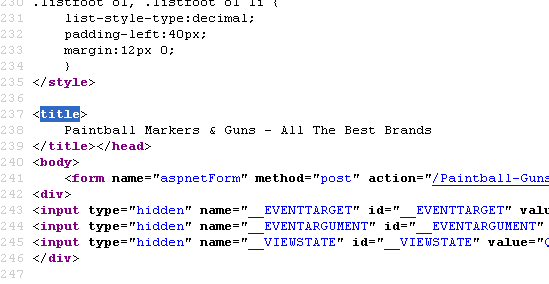 Does the location of the title tag, meta tags, and any structured data have any influence with respect to SEO and search engines? Put another way, could we benefit from moving the title tag up to the top?
I "surfed 'n surfed" and could not find any articles about this.
I would really appreciate any help on this as our site got decimated organically last May and we are looking for any help with SEO.
NIck
0
Does the location of the title tag, meta tags, and any structured data have any influence with respect to SEO and search engines? Put another way, could we benefit from moving the title tag up to the top?
I "surfed 'n surfed" and could not find any articles about this.
I would really appreciate any help on this as our site got decimated organically last May and we are looking for any help with SEO.
NIck
0 -

How do I find which pages are being deindexed on a large site?
Is there an easy way or any way to get a list of all deindexed pages? Thanks for reading!
Technical SEO | | DA20130 -

Are Collapsible DIV's SEO-Friendly?
When I have a long article about a single topic with sub-topics I can make it user friendlier when I limit the text and hide text just showing the next headlines, by using expandable-collapsible div's. My doubt is if Google is really able to read onclick textlinks (with javaScript) or if it could be "seen" as hidden text? I think I read in the SEOmoz Users Guide, that all javaScript "manipulated" contend will not be crawled. So from SEOmoz's Point of View I should better make use of old school named anchors and a side-navigation to jump to the sub-topics? (I had a similar question in my post before, but I did not use the perfect terms to describe what I really wanted. Also my text is not too long (<1000 Words) that I should use pagination with rel="next" and rel="prev" attributes.) THANKS for every answer 🙂
Technical SEO | | inlinear0 -

Duplicate page titles on Ecommerce
Hi, My question is in reference to an E-commerce site- Our SEO MOZ scan is showing many errors for Duplicates- such as Duplicate titles - The majority of these are on the products map- and the page titles are Products Map :: Company Name How do we get correct this or does Google not penalize for it? Thanks.
Technical SEO | | frankrizzo0 -

ECommerce: Best Practice for expired product pages
I'm optimizing a pet supplies site (http://www.qualipet.ch/) and have a question about the best practice for expired product pages. We have thousands of products and hundreds of our offers just exist for a few months. Currently, when a product is no longer available, the site just returns a 404. Now I'm wondering what a better solution could be: 1. When a product disappears, a 301 redirect is established to the category page it in (i.e. leash would redirect to dog accessories). 2. After a product disappers, a customized 404 page appears, listing similar products (but the server returns a 404) I prefer solution 1, but am afraid that having hundreds of new redirects each month might look strange. But then again, returning lots of 404s to search engines is also not the best option. Do you know the best practice for large ecommerce sites where they have hundreds or even thousands of products that appear/disappear on a frequent basis? What should be done with those obsolete URLs?
Technical SEO | | zeepartner1