Moz Q&A is closed.
After more than 13 years, and tens of thousands of questions, Moz Q&A closed on 12th December 2024. Whilst we’re not completely removing the content - many posts will still be possible to view - we have locked both new posts and new replies. More details here.
Indexing product attributes in sitemap
-
Hey Mozzers!
I'm battling a few questions about the sitemap for my ecommerce store. Could you help me out?
- Is it necessary to include your product attributes in the sitemap? I'm not sure why it would matter to have a sitemap that lists everything in the color cherry. Also, if the attributes were included in the sitemap, would that count as duplicate content for the same products to show up in multiple attributes?
- Is there any benefit to submitting the sitemaps individually? For example, submitting /product-sitemap.xml, /product_brand-sitemap.xml versus just /sitemap.xml?
Any other best practices for managing my ecommerce sitemap, or great resources, would be very helpful.
Thank you!
-
Hello Localwork,
By "product attributes" do you mean URLs associated with product variants, like color and size? From the context of your question, I'll assume for now you mean that each product attribute / variant appears on it's own URL (e.g. /?color=red and /?color=blue) and you want to know whether these should be included in the sitemap.
As Andy mentions below, more information is needed before prescribing a best practice specifically to your situation. However, in this case you should probably only have the one "canonical" version of the product URL (e.g. without variants). There are many ways to handle this and I recommend Googling "SEO for product variants" to familiarize yourself with the pros and cons of each.
To answer your question about sitemap segmentation, yes it is a good thing to do for several reasons, most important of which is easier diagnoses of crawl issues, such as which "sections" of your sites have indexation problems. It also helps on large sites with issues reaching URL limits in sitemaps, and is a more logical tree-like structure for people and machines to follow than having every URL in one sitemap.
-
Hi,
Without knowing a little more detail, it's hard to say with 100% certainty, but I can't see why the sitemap should have every iteration of a product in there. These pages (pages that are produced due to an attribute change) should rel=canonical back to the main product page anyway and this will handle duplication.
And unless you many many thousands of products in each sitemap, then you wouldn't want to be splitting them up like this, although you can rationalize these somewhat depending on the products and site.
Just remember that the sitemap is only there as an aid to helping Google crawl and there is no actual SEO benefit to this. It is whatever is going to make the most sense to the site and to Google.
-Andy
Edit: Just Tweeted this out as well to see if others wish to chime in




Got a burning SEO question?
Subscribe to Moz Pro to gain full access to Q&A, answer questions, and ask your own.
Browse Questions
Explore more categories
-
Moz Tools
Chat with the community about the Moz tools.
-
SEO Tactics
Discuss the SEO process with fellow marketers
-
Community
Discuss industry events, jobs, and news!
-
Digital Marketing
Chat about tactics outside of SEO
-
Research & Trends
Dive into research and trends in the search industry.
-
Support
Connect on product support and feature requests.
Related Questions
-

URLs dropping from index (Crawled, currently not indexed)
I've noticed that some of our URLs have recently dropped completely out of Google's index. When carrying out a URL inspection in GSC, it comes up with 'Crawled, currently not indexed'. Strangely, I've also noticed that under referring page it says 'None detected', which is definitely not the case. I wonder if it could be something to do with the following? https://www.seroundtable.com/google-ranking-index-drop-30192.html - It seems to be a bug affecting quite a few people. Here are a few examples of the URLs that have gone missing: https://www.ihasco.co.uk/courses/detail/sexual-harassment-awareness-training https://www.ihasco.co.uk/courses/detail/conflict-resolution-training https://www.ihasco.co.uk/courses/detail/prevent-duty-training Any help here would be massively appreciated!
Technical SEO | | iHasco0 -

Problems with WooCommerce Product Attribute Filter URL's
I am running a WordPress/WooCommerce site for a client, and Moz is picking up some issues with URL's generated from WooCommerce product attribute filters. For example: ..co.uk/womens-prescription-glasses/?filter_gender=mens&filter_style=full-rim&filter_shape=oval How do I get Google to ignore these filters?
Technical SEO | | SushiUK
I am running Yoast Premium, but not sure if this can solve the issue? Product categories are canonicalised to the root category URL. Any suggestions very gratefully appreciated. Thanks Bob0 -

How to deal with duplicated content on product pages?
Hi, I have a webshop with products with different sizes and colours. For each item I have a different URL, with almost the same content (title tag, product descriptions, etc). In order to prevent duplicated content I'am wondering what is the best way to solve this problem, keeping in mind: -Impossible to create one page/URL for each product with filters on colour and size -Impossible to rewrite the product descriptions in order to be unique I'm considering the option to canonicolize the rest of de colours/size variations, but the disadvantage is that in case the product is not in stock it disappears from the website. Looking forward to your opinions and solutions. Jeroen
Technical SEO | | Digital-DMG0 -

Sitemap indexed pages dropping
About a month ago I noticed my pages indexed from my sitemap are dropping.There are 134 pages in my sitemap and only 11 are indexed. It used to be 117 pages and just died off quickly. I still seem to be getting consistant search traffic but I'm just not sure whats causing this. There are no warnings or manual actions required in GWT that I can find.
Technical SEO | | zenstorageunits0 -

How to block text on a page to be indexed?
I would like to block the spider indexing a block of text inside a page , however I do not want to block the whole page with, for example , a noindex tag. I have tried already with a tag like this : chocolate pudding chocolate pudding However this is not working for my case, a travel related website. thanks in advance for your support. Best regards Gianluca
Technical SEO | | CharmingGuy0 -

Should all pagination pages be included in sitemaps
How important is it for a sitemap to include all individual urls for the paginated content. Assuming the rel next and prev tags are set up would it be ok to just have the page 1 in the sitemap ?
Technical SEO | | Saijo.George0 -
Image Indexing Issue by Google
Hello All,My URL is: www.thesalebox.comI have Submitted my image Sitemap in google webmaster tool on 10th Oct 2013,Still google could not indexing any of my web images,Please refer my sitemap - www.thesalebox.com/AppliancesHomeEntertainment.xml and www.thesalebox.com/Hardware.xmland my webmaster status and image indexing status are below,
Technical SEO | | CommercePundit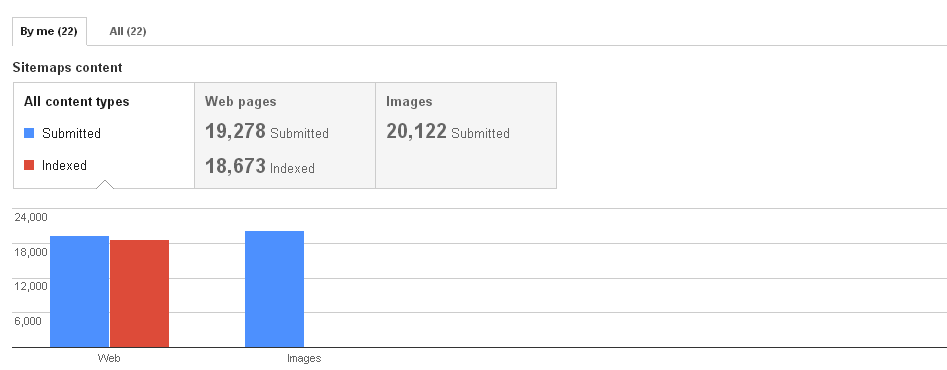 Can you please help me, why my images are not indexing in google yet? is there any issue? please give me suggestions?Thanks!
0
Can you please help me, why my images are not indexing in google yet? is there any issue? please give me suggestions?Thanks!
0 -

Host sitemaps on S3?
Hey guys, I run a dynamic web service and I will start building static sitemaps for it pretty soon. The fact that my app lives in a multitude of servers doesn't make it easy to distribute frequently updated static files throughout the servers. My idea was to host the files in AWS S3 and point my robots.txt sitemap directive there. I'll use a sitemap index so, every other sitemap will be hosted on S3 as well. I could dynamically mirror the content from the files in S3 through my app, but that would be a little more resource intensive than just serving the static files from a common place. Any ideas? Thanks!
Technical SEO | | tanlup0
