Moz Q&A is closed.
After more than 13 years, and tens of thousands of questions, Moz Q&A closed on 12th December 2024. Whilst we’re not completely removing the content - many posts will still be possible to view - we have locked both new posts and new replies. More details here.
Indexing product attributes in sitemap
-
Hey Mozzers!
I'm battling a few questions about the sitemap for my ecommerce store. Could you help me out?
- Is it necessary to include your product attributes in the sitemap? I'm not sure why it would matter to have a sitemap that lists everything in the color cherry. Also, if the attributes were included in the sitemap, would that count as duplicate content for the same products to show up in multiple attributes?
- Is there any benefit to submitting the sitemaps individually? For example, submitting /product-sitemap.xml, /product_brand-sitemap.xml versus just /sitemap.xml?
Any other best practices for managing my ecommerce sitemap, or great resources, would be very helpful.
Thank you!
-
Hello Localwork,
By "product attributes" do you mean URLs associated with product variants, like color and size? From the context of your question, I'll assume for now you mean that each product attribute / variant appears on it's own URL (e.g. /?color=red and /?color=blue) and you want to know whether these should be included in the sitemap.
As Andy mentions below, more information is needed before prescribing a best practice specifically to your situation. However, in this case you should probably only have the one "canonical" version of the product URL (e.g. without variants). There are many ways to handle this and I recommend Googling "SEO for product variants" to familiarize yourself with the pros and cons of each.
To answer your question about sitemap segmentation, yes it is a good thing to do for several reasons, most important of which is easier diagnoses of crawl issues, such as which "sections" of your sites have indexation problems. It also helps on large sites with issues reaching URL limits in sitemaps, and is a more logical tree-like structure for people and machines to follow than having every URL in one sitemap.
-
Hi,
Without knowing a little more detail, it's hard to say with 100% certainty, but I can't see why the sitemap should have every iteration of a product in there. These pages (pages that are produced due to an attribute change) should rel=canonical back to the main product page anyway and this will handle duplication.
And unless you many many thousands of products in each sitemap, then you wouldn't want to be splitting them up like this, although you can rationalize these somewhat depending on the products and site.
Just remember that the sitemap is only there as an aid to helping Google crawl and there is no actual SEO benefit to this. It is whatever is going to make the most sense to the site and to Google.
-Andy
Edit: Just Tweeted this out as well to see if others wish to chime in




Got a burning SEO question?
Subscribe to Moz Pro to gain full access to Q&A, answer questions, and ask your own.
Browse Questions
Explore more categories
-
Moz Tools
Chat with the community about the Moz tools.
-
SEO Tactics
Discuss the SEO process with fellow marketers
-
Community
Discuss industry events, jobs, and news!
-
Digital Marketing
Chat about tactics outside of SEO
-
Research & Trends
Dive into research and trends in the search industry.
-
Support
Connect on product support and feature requests.
Related Questions
-

Discovered - currently not indexed issue
Hello all, We have a sitemap with URLs that have mostly user generated content. Profile Overview section. Where users write about their services and some other things. Out of 46K URLs, only 14K are valid according to search console and 32K URLs are excluded. Out of these 32K, 28K are "Discovered - currently not indexed". We can't really update these pages as they have user generated content. However we do want to leverage all these pages to help us in our SEO. So the question is how do we make all of these pages indexable? If anyone can help in the regard, please let me know. Thanks!
Technical SEO | | akashkandari0 -

Google not Indexing images on CDN.
My URL is: https://bit.ly/2hWAApQ We have set up a CDN on our own domain: https://bit.ly/2KspW3C We have a main xml sitemap: https://bit.ly/2rd2jEb and https://bit.ly/2JMu7GB is one the sub sitemaps with images listed within. The image sitemap uses the CDN URLs. We verified the CDN subdomain in GWT. The robots.txt does not restrict any of the photos: https://bit.ly/2FAWJjk. Yet, GWT still reports none of our images on the CDN are indexed. I ve followed all the steps and still none of the images are being indexed. My problem seems similar to this ticket https://bit.ly/2FzUnBl but however different because we don't have a separate image sitemap but instead have listed image urls within the sitemaps itself. Can anyone help please? I will promptly respond to any queries. Thanks
Technical SEO | | TNZ
Deepinder0 -

Fake Links indexing in google
Hello everyone, I have an interesting situation occurring here, and hoping maybe someone here has seen something of this nature or be able to offer some sort of advice. So, we recently installed a wordpress to a subdomain for our business and have been blogging through it. We added the google webmaster tools meta tag and I've noticed an increase in 404 links. I brought this up to or server admin, and he verified that there were a lot of ip's pinging our server looking for these links that don't exist. We've combed through our server files and nothing seems to be compromised. Today, we noticed that when you do site:ourdomain.com into google the subdomain with wordpress shows hundreds of these fake links, that when you visit them, return a 404 page. Just curious if anyone has seen anything like this, what it may be, how we can stop it, could it negatively impact us in anyway? Should we even worry about it? Here's the link to the google results. https://www.google.com/search?q=site%3Amshowells.com&oq=site%3A&aqs=chrome.0.69i59j69i57j69i58.1905j0j1&sourceid=chrome&es_sm=91&ie=UTF-8 (odd links show up on pages 2-3+)
Technical SEO | | mshowells0 -

How to block text on a page to be indexed?
I would like to block the spider indexing a block of text inside a page , however I do not want to block the whole page with, for example , a noindex tag. I have tried already with a tag like this : chocolate pudding chocolate pudding However this is not working for my case, a travel related website. thanks in advance for your support. Best regards Gianluca
Technical SEO | | CharmingGuy0 -
Image Indexing Issue by Google
Hello All,My URL is: www.thesalebox.comI have Submitted my image Sitemap in google webmaster tool on 10th Oct 2013,Still google could not indexing any of my web images,Please refer my sitemap - www.thesalebox.com/AppliancesHomeEntertainment.xml and www.thesalebox.com/Hardware.xmland my webmaster status and image indexing status are below,
Technical SEO | | CommercePundit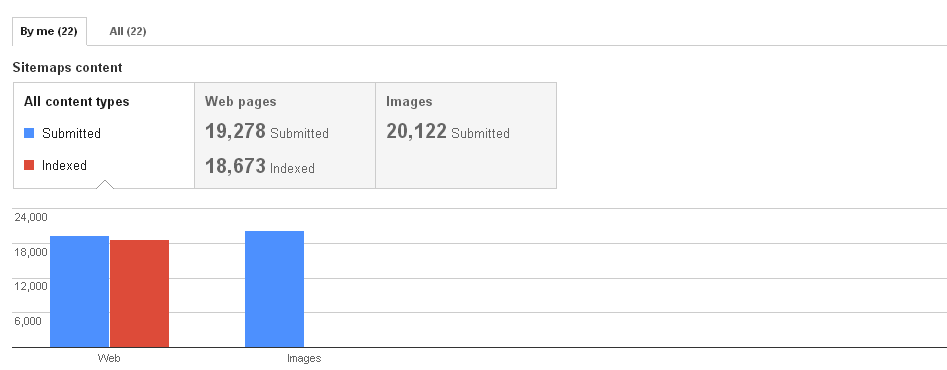 Can you please help me, why my images are not indexing in google yet? is there any issue? please give me suggestions?Thanks!
0
Can you please help me, why my images are not indexing in google yet? is there any issue? please give me suggestions?Thanks!
0 -

Can you have a /sitemap.xml and /sitemap.html on the same site?
Thanks in advance for any responses; we really appreciate the expertise of the SEOmoz community! My question: Since the file extensions are different, can a site have both a /sitemap.xml and /sitemap.html both siting at the root domain? For example, we've already put the html sitemap in place here: https://www.pioneermilitaryloans.com/sitemap Now, we're considering adding an XML sitemap. I know standard practice is to load it at the root (www.example.com/sitemap.xml), but am wondering if this will cause conflicts. I've been unable to find this topic addressed anywhere, or any real-life examples of sites currently doing this. What do you think?
Technical SEO | | PioneerServices0 -

Is it worth setting up 301 redirects from old products to new products?
This year we are using a new supplier and they have provided us a product database of approx. 5k products. About 80% of these products were in our existing database but once we have installed the new database all the URLs will have changed. There is no quick way to match the old products with the new products so we would have to manually match all 5k products if we were were to setup 301 rules for the old products pointing to the new products. Of course this would take a lot of time. So the options are: 1. Is it worth putting in this effort to make the 301 rules? 2. Or are we okay just to delete the old product pages, let the SE see the 404 and just wait for it to index the new pages? 3. Or, as a compromise, should we 301 the old product page to the new category page as this is a lot quicker for us do do than redirecting to the new product page?
Technical SEO | | indigoclothing0 -

/index.php in sitemap? take it out?
Hi Everyone, The following was automatically generated at xml-sitemaps.com Should I get rid of the index.php url from my sitemap? If so, how do I go about redirecting it in my htaccess ? <url><loc>http://www.mydomain.ca/</loc></url>
Technical SEO | | RogersSEO
<url><loc>http://www.mydomain.ca/index.php</loc></url> thank you in advance, Martin0
