Moz Q&A is closed.
After more than 13 years, and tens of thousands of questions, Moz Q&A closed on 12th December 2024. Whilst we’re not completely removing the content - many posts will still be possible to view - we have locked both new posts and new replies. More details here.
Are Collapsible DIV's SEO-Friendly?
-
When I have a long article about a single topic with sub-topics I can make it user friendlier when I limit the text and hide text just showing the next headlines, by using expandable-collapsible div's.
My doubt is if Google is really able to read onclick textlinks (with javaScript) or if it could be "seen" as hidden text?
I think I read in the SEOmoz Users Guide, that all javaScript "manipulated" contend will not be crawled. So from SEOmoz's Point of View I should better make use of old school named anchors and a side-navigation to jump to the sub-topics?
(I had a similar question in my post before, but I did not use the perfect terms to describe what I really wanted. Also my text is not too long (<1000 Words) that I should use pagination with rel="next" and rel="prev" attributes.)
THANKS for every answer

-
Expandable and collapible DIV's are just fine for SEO. They do a great job of accomplishing great design without compromsing content for SEO. Yes, Google can crawl that content just fine. Here's a link to a great webinar that specifically addresses some great Pro-Tips regarding how best to use these: http://www.seomoz.org/webinars/designing-for-seo
Hope that helps!
Dana


Got a burning SEO question?
Subscribe to Moz Pro to gain full access to Q&A, answer questions, and ask your own.
Browse Questions
Explore more categories
-
Moz Tools
Chat with the community about the Moz tools.
-
SEO Tactics
Discuss the SEO process with fellow marketers
-
Community
Discuss industry events, jobs, and news!
-
Digital Marketing
Chat about tactics outside of SEO
-
Research & Trends
Dive into research and trends in the search industry.
-
Support
Connect on product support and feature requests.
Related Questions
-

Problem with Yoast not seeing any of this website's text/content
Hi, My client has a new WordPress site http://www.londonavsolutions.co.uk/ and they have installed the Yoast Premium SEO plug-in. They are having issues with getting the lights to go green and the main problem is that on most pages Yoast does not see any words/content – although there are plenty of words on the pages. Other tools can see the words, however Yoast is struggling to find any and gives the following message:- Bad SEO score. The text contains 0 words. This is far below the recommended minimum of 300 words. Add more content that is relevant for the topic. Readability - You have far too little content. Please add some content to enable a good analysis. They have contacted the website developer who says that there is nothing wrong, but they are frustrated that they cannot use the Yoast tools themselves because of this issue, plus Yoast are offering no support with the issue. I hope that one of you guys has seen this problem before, or can spot a problem with the way the site has been built and can perhaps shed some light on the problem. I didn't build the site myself so won't be offended if you spot problems with it. Thanks in advance, Ben
Technical SEO | | bendyman0 -

URL Structure On Site - Currently it's domain/product-name NOT domain/category/product name is this bad?
I have a eCommerce site and the site structure is domain/product-name rather than domain/product-category/product-name Do you think this will have a negative impact SEO Wise? I have seen that some of my individual product pages do get better rankings than my categories.
Technical SEO | | the-gate-films0 -

Good alternatives to Xenu's Link Sleuth and AuditMyPc.com Sitemap Generator
I am working on scraping title tags from websites with 1-5 million pages. Xenu's Link Sleuth seems to be the best option for this, at this point. Sitemap Generator from AuditMyPc.com seems to be working too, but it starts handing up, when a sitemap file, the tools is working on,becomes too large. So basically, the second one looks like it wont be good for websites of this size. I know that Scrapebox can scrape title tags from list of url, but this is not needed, since this comes with both of the above mentioned tools. I know about DeepCrawl.com also, but this one is paid, and it would be very expensive with this amount of pages and websites too (5 million ulrs is $1750 per month, I could get a better deal on multiple websites, but this obvioulsy does not make sense to me, it needs to be free, more or less). Seo Spider from Screaming Frog is not good for large websites. So, in general, what is the best way to work on something like this, also time efficient. Are there any other options for this? Thanks.
Technical SEO | | blrs120 -

Does Title Tag location in a page's source code matter?
Currently our meta description is on line 8 for our page - http://www.paintball-online.com/Paintball-Guns-And-Markers-0Y.aspx
Technical SEO | | Istoresinc The title tag, however sits below a bunch of code on line 237
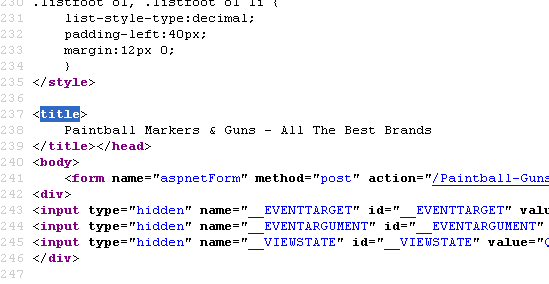 Does the location of the title tag, meta tags, and any structured data have any influence with respect to SEO and search engines? Put another way, could we benefit from moving the title tag up to the top?
I "surfed 'n surfed" and could not find any articles about this.
I would really appreciate any help on this as our site got decimated organically last May and we are looking for any help with SEO.
NIck
0
Does the location of the title tag, meta tags, and any structured data have any influence with respect to SEO and search engines? Put another way, could we benefit from moving the title tag up to the top?
I "surfed 'n surfed" and could not find any articles about this.
I would really appreciate any help on this as our site got decimated organically last May and we are looking for any help with SEO.
NIck
0 -

Ecommerce website: Product page setup & SKU's
I manage an E-commerce website and we are looking to make some changes to our product pages to try and optimise them for search purposes and to try and improve the customer buying experience. This is where my head starts to hurt! Now, let's say I am selling a T shirt that comes in 4 sizes and 6 different colours. At the moment my website would have 24 products, each with pretty much the same content (maybe differing references to the colour & size). My idea is to change this and have 1 main product page for the T-shirt, but to have 24 product SKU's/variations that exist to give the exact product details. Some different ways I have been considering to do this: a) have drop-down fields on the product page that ask the customer to select their Tshirt size and colour. The image & price then changes on the page. b) All product 24 product SKUs sre listed under the main product with the 'Add to Cart' open next to each one. Each one would be clickable so a page it its own right. Would I need to set up a canonical links for each SKU that point to the top level product page? I'm obviously looking to minimise duplicate content but Im not exactly sure on how to set this up - its a big decision so I need to be 100% clear before signing off on anything. . Any other tips on how to do this or examples of good e-commerce websites that use product SKus well? Kind regards Tom
Technical SEO | | DHS_SH0 -

Best Practices for adding Dynamic URL's to XML Sitemap
Hi Guys, I'm working on an ecommerce website with all the product pages using dynamic URL's (we also have a few static pages but there is no issue with them). The products are updated on the site every couple of hours (because we sell out or the special offer expires) and as a result I keep seeing heaps of 404 errors in Google Webmaster tools and am trying to avoid this (if possible). I have already created an XML sitemap for the static pages and am now looking at incorporating the dynamic product pages but am not sure what is the best approach. The URL structure for the products are as follows: http://www.xyz.com/products/product1-is-really-cool
Technical SEO | | seekjobs
http://www.xyz.com/products/product2-is-even-cooler
http://www.xyz.com/products/product3-is-the-coolest Here are 2 approaches I was considering: 1. To just include the dynamic product URLS within the same sitemap as the static URLs using just the following http://www.xyz.com/products/ - This is so spiders have access to the folder the products are in and I don't have to create an automated sitemap for all product OR 2. Create a separate automated sitemap that updates when ever a product is updated and include the change frequency to be hourly - This is so spiders always have as close to be up to date sitemap when they crawl the sitemap I look forward to hearing your thoughts, opinions, suggestions and/or previous experiences with this. Thanks heaps, LW0 -

Blocking URL's with specific parameters from Googlebot
Hi, I've discovered that Googlebot's are voting on products listed on our website and as a result are creating negative ratings by placing votes from 1 to 5 for every product. The voting function is handled using Javascript, as shown below, and the script prevents multiple votes so most products end up with a vote of 1, which translates to "poor". How do I go about using robots.txt to block a URL with specific parameters only? I'm worried that I might end up blocking the whole product listing, which would result in de-listing from Google and the loss of many highly ranked pages. DON'T want to block: http://www.mysite.com/product.php?productid=1234 WANT to block: http://www.mysite.com/product.php?mode=vote&productid=1234&vote=2 Javacript button code: onclick="javascript: document.voteform.submit();" Thanks in advance for any advice given. Regards,
Technical SEO | | aethereal
Asim0 -

A question about RSS feeds and nofollow's
With the nofollow tag used very widely on the internet these days I was just wondering about how an RSS feed might help me find a way around it. Basically my question is this : I post a comment on a blog, it's approved and my comment together with my link(nofollow tag applied) is there. Now when the blogs RSS feed updates, does this nofollow tag get applied to the feed? As far as I can tell it does not - but I'm not too clue'd up on how the feed is generated. Anyone want to help me understand how it works and if what I'm suggesting would be 'a way around the nofollow tag' ? Thanks 🙂
Technical SEO | | DanHill0