Moz Q&A is closed.
After more than 13 years, and tens of thousands of questions, Moz Q&A closed on 12th December 2024. Whilst we’re not completely removing the content - many posts will still be possible to view - we have locked both new posts and new replies. More details here.
Screaming From occurences and canonicals what does it all mean
-
Bonjourno from Wetherby UK...
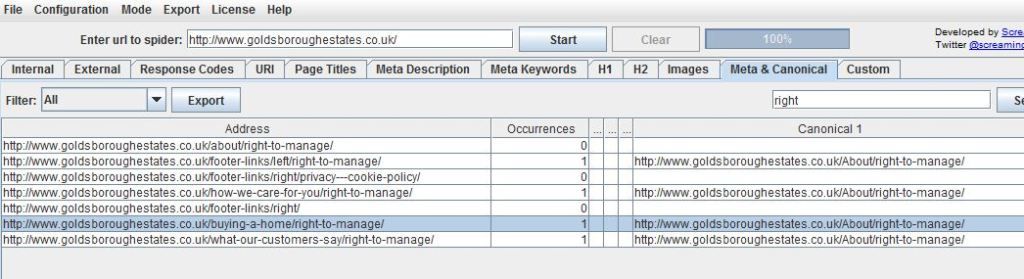
Ive used a package called screamong frog to diagnose canonical errors but can anyone tell me what this means? http://i216.photobucket.com/albums/cc53/zymurgy_bucket/understand-occurances-canonical.jpg
Thanks in advance.
David
-
Thank you for all your replies this was bugging me but the pain of not knowing has vanished like the morning mist as the warming glow of sunshine illumunates truth

-
David
Looks like you may have an issue there. The "address" and "canonical 1" should match about 99% of the time. Right now you're telling Google to index all those different address pages as a single URL (About/right-to-manage)... something to look at - and the suggestions below are both good as well.
-Dan
-
I agree with what Streamline Metrics said, I just want to add to this by linking you to a great SEOmoz post on canonicalization which may help you clear things up more.
In your case, having 1 rel="canonical" tag per page is what you want, so you should be fine with that, just make sure that the canonical tags (listed under canonical 1 in Screaming Frog) is the actual URL that you want.
Hope this helps
Zach -
It simply means how many canonical tags are found on that specific page. So if you had two rel=canonical tags on a page, it would say 2 occurrences. For more info, check out http://www.screamingfrog.co.uk/seo-spider/user-guide/tabs/





Got a burning SEO question?
Subscribe to Moz Pro to gain full access to Q&A, answer questions, and ask your own.
Browse Questions
Explore more categories
-
Moz Tools
Chat with the community about the Moz tools.
-
SEO Tactics
Discuss the SEO process with fellow marketers
-
Community
Discuss industry events, jobs, and news!
-
Digital Marketing
Chat about tactics outside of SEO
-
Research & Trends
Dive into research and trends in the search industry.
-
Support
Connect on product support and feature requests.
Related Questions
-

What is the correct Canonical tag on m.site?
We have 2 separate sites for desktop (www.example.com) and mobile (m.example.com) As per the guideline, we have added Rel=alternate tag on www.example.com to point to mobile URL(m.example.com) and Rel=canonical tag on m.example.com to point to Desktop site(www.example.com).However, i didn't find any guideline on what canonical tag we should add ifFor Desktop sitewww.example.com/PageA - has a canonical tag to www.example.com/PageBOn this page, we have a Rel=alternate tag m.example.com/pageAWhat will be the canonical we should add for the mobile version of Page Am.example.com/PageA - Canonical tag point to www.example.com/PageA -or www.example.com/PageB?Kalpesh
Technical SEO | | kguard0 -

Trailing slash URLs and canonical links
Hi, I've seen a fair amount of topics speaking about the difference between domain names ending with or without trailing slashes, the impact on crawlers and how it behaves with canonical links.
Technical SEO | | GhillC
However, it sticks to domain names only.
What about subfolders and pages then? How does it behaves with those? Say I've a site structured like this:
https://www.domain.com
https://www.domain.com/page1 And for each of my pages, I've an automatic canonical link ending with a slash.
Eg. rel="canonical" href="https://www.domain.com/page1/" /> for the above page. SEM Rush flags this as a canonical error. But is it exactly?
Are all my canonical links wrong because of that slash? And as subsidiary question, both domain.com/page1 and domain.com/page1/ are accessible. Is it this a mistake or it doesn't make any difference (I've read that those are considered different pages)? Thanks!
G0 -

Do Canonical Tags Pass Link Juice?
I have an ecommerce website where some pages link to a product page with a different URL. EXAMPLE: 1: /category/product1.html (not indexed by Google) with canonical pointing to product1.html Other page link to the product like below. 2: product1.html (indexed by Google) Now the question is, does 1: pass any link juice to product1.html or not? Is it worth to change everything and link only to one URL? My site is running on Magento!
Technical SEO | | bill3690 -

URL has caps, but canonical does not. Now what?
Hi, Just started working with a site that has the occasional url with a capital, but then the url in the canonical as lower case. Neither, when entered in a browser, resolves to the other. It's a Shopify site. What do you think I should do?
Technical SEO | | 945010 -

Can you use Screaming Frog to find all instances of relative or absolute linking?
My client wants to pull every instance of an absolute URL on their site so that they can update them for an upcoming migration to HTTPS (the majority of the site uses relative linking). Is there a way to use the extraction tool in Screaming Frog to crawl one page at a time and extract every occurrence of _href="http://" _? I have gone back and forth between using an x-path extractor as well as a regex and have had no luck with either. Ex. X-path: //*[starts-with(@href, “http://”)][1] Ex. Regex: href=\”//
Technical SEO | | Merkle-Impaqt0 -

I need help with a PHP canonical URL tags
I found a little difficult for me to do a canonical tag in my PHP. On-Page Report Card We check to make sure that IF you use canonical URL tags, it points to the right page. If the canonical tag points to a different URL, engines will not count this page as the reference resource and thus, it won't have an opportunity to rank. If you've not made this page the rel=canonical target, change the reference to this URL. NOTE: For pages not employing canonical URL tags, this factor does not apply. I don't know how to tidy my PHP Any suggestion.
Technical SEO | | lnietob0 -

Adding Rel Canonical to multiple pages
Hi, Our CMS generates a lot of duplicate content, (Different versions of every page for 3 different font sizes). There are many other reasons why we should drop this current CMS and go with something else, and we are in the process of doing that. But for now, does anyone know how would I do the following: I've created a spreadsheet that contains the following: Column 1: rel="canonical" tag for URL Column 2: Duplicate Content URL # 1 Column 3: Duplicate Content URL # 2 Column 4: Duplicate Content URL # 3 I want to add the tag from column 1 into the head of every page from column 2,3, and 4. What would be a fast way to do this considering that I have around 1800 rows. Check the screenshot of the builtwith.com result to see more information about the website if that helps. Farris bxySL
Technical SEO | | jdossetti0 -

Robots.txt and canonical tag
In the SEOmoz post - http://www.seomoz.org/blog/robot-access-indexation-restriction-techniques-avoiding-conflicts, it's being said - If you have a robots.txt disallow in place for a page, the canonical tag will never be seen. Does it so happen that if a page is disallowed by robots.txt, spiders DO NOT read the html code ?
Technical SEO | | seoug_20050