Moz Q&A is closed.
After more than 13 years, and tens of thousands of questions, Moz Q&A closed on 12th December 2024. Whilst we’re not completely removing the content - many posts will still be possible to view - we have locked both new posts and new replies. More details here.
Screaming From occurences and canonicals what does it all mean
-
Bonjourno from Wetherby UK...
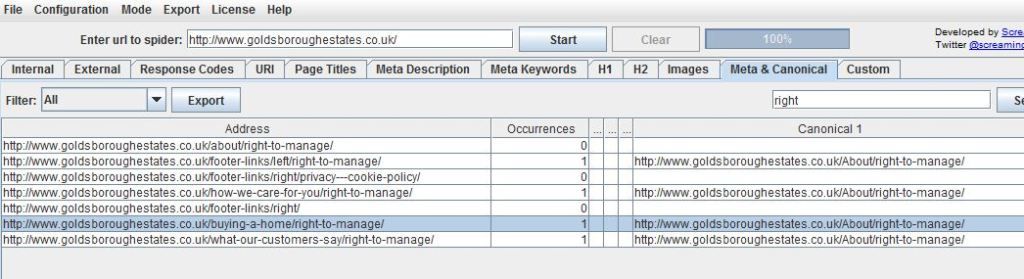
Ive used a package called screamong frog to diagnose canonical errors but can anyone tell me what this means? http://i216.photobucket.com/albums/cc53/zymurgy_bucket/understand-occurances-canonical.jpg
Thanks in advance.
David
-
Thank you for all your replies this was bugging me but the pain of not knowing has vanished like the morning mist as the warming glow of sunshine illumunates truth

-
David
Looks like you may have an issue there. The "address" and "canonical 1" should match about 99% of the time. Right now you're telling Google to index all those different address pages as a single URL (About/right-to-manage)... something to look at - and the suggestions below are both good as well.
-Dan
-
I agree with what Streamline Metrics said, I just want to add to this by linking you to a great SEOmoz post on canonicalization which may help you clear things up more.
In your case, having 1 rel="canonical" tag per page is what you want, so you should be fine with that, just make sure that the canonical tags (listed under canonical 1 in Screaming Frog) is the actual URL that you want.
Hope this helps
Zach -
It simply means how many canonical tags are found on that specific page. So if you had two rel=canonical tags on a page, it would say 2 occurrences. For more info, check out http://www.screamingfrog.co.uk/seo-spider/user-guide/tabs/





Got a burning SEO question?
Subscribe to Moz Pro to gain full access to Q&A, answer questions, and ask your own.
Browse Questions
Explore more categories
-
Moz Tools
Chat with the community about the Moz tools.
-
SEO Tactics
Discuss the SEO process with fellow marketers
-
Community
Discuss industry events, jobs, and news!
-
Digital Marketing
Chat about tactics outside of SEO
-
Research & Trends
Dive into research and trends in the search industry.
-
Support
Connect on product support and feature requests.
Related Questions
-

Dynamic Canonical Tag for Search Results Filtering Page
Hi everyone, I run a website in the travel industry where most users land on a location page (e.g. domain.com/product/location, before performing a search by selecting dates and times. This then takes them to a pre filtered dynamic search results page with options for their selected location on a separate URL (e.g. /book/results). The /book/results page can only be accessed on our website by performing a search, and URL's with search parameters from this page have never been indexed in the past. We work with some large partners who use our booking engine who have recently started linking to these pre filtered search results pages. This is not being done on a large scale and at present we only have a couple of hundred of these search results pages indexed. I could easily add a noindex or self-referencing canonical tag to the /book/results page to remove them, however it’s been suggested that adding a dynamic canonical tag to our pre filtered results pages pointing to the location page (based on the location information in the query string) could be beneficial for the SEO of our location pages. This makes sense as the partner websites that link to our /book/results page are very high authority and any way that this could be passed to our location pages (which are our most important in terms of rankings) sounds good, however I have a couple of concerns. • Is using a dynamic canonical tag in this way considered spammy / manipulative? • Whilst all the content that appears on the pre filtered /book/results page is present on the static location page where the search initiates and which the canonical tag would point to, it is presented differently and there is a lot more content on the static location page that isn’t present on the /book/results page. Is this likely to see the canonical tag being ignored / link equity not being passed as hoped, and are there greater risks to this that I should be worried about? I can’t find many examples of other sites where this has been implemented but the closest would probably be booking.com. https://www.booking.com/searchresults.it.html?label=gen173nr-1FCAEoggI46AdIM1gEaFCIAQGYARS4ARfIAQzYAQHoAQH4AQuIAgGoAgO4ArajrpcGwAIB0gIkYmUxYjNlZWMtYWQzMi00NWJmLTk5NTItNzY1MzljZTVhOTk02AIG4AIB&sid=d4030ebf4f04bb7ddcb2b04d1bade521&dest_id=-2601889&dest_type=city& Canonical points to https://www.booking.com/city/gb/london.it.html In our scenario however there is a greater difference between the content on both pages (and booking.com have a load of search results pages indexed which is not what we’re looking for) Would be great to get any feedback on this before I rule it out. Thanks!
Technical SEO | | GAnalytics1 -

Canonical or hreflang?
I have four English sites for four different countries, UK, Ireland, Australia and New Zealand and I want to share some content between the sites. On the pages that share the content, which is essentially exactly the same on all 4 sites, do I use the hreflang tags like: or do I add a canonical tag to the other three pointing to the "origin", which would be the UK site? I believe it is best practice to use one or the other, but I'm not sure which make sense in this situation.
Technical SEO | | andrew-mso0 -

Should I use a canonical URL for images uploaded to a blog post in Wordpress?
Hi, I have a wordpress website that has articles/news posts witch contain imagery. I've noticed that in the Media Library, when you upload an image to a blog post it generates a new permalink ...article-name/article-image-01.jpg I have Yoast SEO plugin and have the option to set a canonical URL for this image. Should I point it back to the actual article? Thanks for any helpers with this.
Technical SEO | | Easigrass0 -

Rel=Canonical For Landing Pages
We have PPC landing pages that are also ranking in organic search. We've decided to create new landing pages that have been improved to rank better in natural search. The PPC team however wants to use their original landing pages so we are unable to 301 these pages to the new pages being created. We need to block the old PPC pages from search. Any idea if we can use rel=canonical? The difference between old PPC page and new landing page is much more content to support keyword targeting and provide value to users. Google says it's OK to use rel=canonical if pages are similar but not sure if this applies to us. The old PPC pages have 1 paragraph of content followed by featured products for sale. The new pages have 4-5 paragraphs of content and many more products for sale. The other option would be to add meta noindex to the old PPC landing pages. Curious as to what you guys think. Thanks.
Technical SEO | | SoulSurfer80 -
Does Google read dynamic canonical tags?
Does Google recognize rel=canonical tag if loaded dynamically via javascript? Here's what we're using to load: <script> //Inject canonical link into page head if (window.location.href.indexOf("/subdirname1") != -1) { canonicalLink = window.location.href.replace("/kapiolani", ""); } if (window.location.href.indexOf("/subdirname2") != -1) { canonicalLink = window.location.href.replace("/straub", ""); } if (window.location.href.indexOf("/subdirname3") != -1) { canonicalLink = window.location.href.replace("/pali-momi", ""); } if (window.location.href.indexOf("/subdirname4") != -1) { canonicalLink = window.location.href.replace("/wilcox", ""); } if (canonicalLink != window.location.href) { var link = document.createElement('link'); link.rel = 'canonical'; link.href = canonicalLink; document.head.appendChild(link); } script>
Technical SEO | | SoulSurfer80 -

Do you need a canonical tag for search and filter pages?
Hi Moz Community, We've been implementing new canonical tags for our category pages but I have a question about pages that are found via search and our filtering options. Would we still need a canonical tag for pages that show up in search + a filter option if it only lists one page of items? Example below. www.uncommongoods.com/search.html/find/?q=dog&exclusive=1 Thanks!
Technical SEO | | znotes0 -

Removing a canonical tag from Pagination pages
Hello, Currently on our site we have the rel=prev/next markup for pagination along with a self pointing canonical via the Yoast Plugin. However, on page 2 of our paginated series, (there's only 2 pages currently), the canonical points to page one, rather than page 2. My understanding is that if you use a canonical on paginated pages it should point to a viewall page as opposed to page one. I also believe that you don't need to use both a canonical and the rel=prev/next markup, one or the other will do. As we use the markup I wanted to get rid of the canonical, would this be correct? For those who use the Yoast Plugin have you managed to get that to work? Thanks!
Technical SEO | | jessicarcf0 -

Rel=Canonical, WWW vs non WWW and SEO
Okay so I'm a bit of a loss here. For what ever reason just about every single Wordpress site I has will turn www.mysite.com into mysite.com in the browser bar. I assume this is the rel=canonical tag at work, there are no 301s on my site. When I use the Open Site Explorer and type in www.mysite.com it shows a domain authority of around 40 and a few hundred backlinks... and then I get the message. Oh Hey! It looks like that URL redirects to XXXXXX. Would you like to see data for <a class="clickable redirects">that URL instead</a>? So if I click to see this data instead I have less than half of that domain authority and about 2 backlinks. *** Does this make a difference SEO wise? Should my non WWW be redirecting to my WWW instead because that's where the domain authority and backlinks are? Why am I getting two different domain authority and backlink counts if they are essentially the same? Or am I wrong and all that link juice and authority passes just the same?
Technical SEO | | twilightofidols0