Moz Q&A is closed.
After more than 13 years, and tens of thousands of questions, Moz Q&A closed on 12th December 2024. Whilst we’re not completely removing the content - many posts will still be possible to view - we have locked both new posts and new replies. More details here.
Unsolved Capturing Source Dynamically for UTM Parameters
-
Does anyone have a tutorial on how to dynamically capture the referring source to be populated in UTM parameters for Google Analytics?
We want to syndicate content and be able to see all of the websites that provided referral traffic for this specific objective. We want to set a specific utm_medium and utm_campaign but have the utm_source be dynamic and capture the referring website.
If we set a permanent utm_source, it would appear the same for all incoming traffic.
Thanks in advance!
-
@peteboyd said in Capturing Source Dynamically for UTM Parameters:
Thanks in advance!
UTM (Urchin Tracking Module) parameters are tags that you can add to the end of a URL in order to track the effectiveness of your marketing campaigns. These parameters are used by Google Analytics to help you understand how users are interacting with your website and where they are coming from.
There are five different UTM parameters that you can use:
utm_source: This parameter specifies the source of the traffic, such as "google" or "Facebook".
utm_medium: This parameter specifies the medium of the traffic, such as "cpc" (cost-per-click) or "social".
utm_campaign: This parameter specifies the name of the campaign, such as "spring_sale" or "promotion".
utm_term: This parameter specifies the term or keywords used in the campaign, such as "shoes" or "dress".
utm_content: This parameter specifies the content of the ad, such as the headline or the call-to-action.
To capture the source dynamically for UTM parameters, you can use JavaScript to get the value of the document. referrer property. This property returns the URL of the page that is linked to the current page. You can then use this value to set the utm_source parameter dynamically.
For example, you might use the following code to set the utm_source parameter based on the referring URL:
Copy code
var utmSource = '';if (document.referrer.indexOf('google') !== -1) {
utmSource = 'google';
} else if (document.referrer.indexOf('facebook') !== -1) {
utmSource = 'facebook';
}// Add the utm_source parameter to the URL
var url = 'http://www.example.com?utm_source=' + utmSource;
This code will set the utm_source parameter to "google" if the user came to the page from a Google search or to "Facebook" if the user came to the page from Facebook. If the user came to the page from another source, the utm_source parameter will be left empty.You can then use this modified URL in your marketing campaigns to track the effectiveness of your campaigns and understand where your traffic is coming from.
-
@peteboyd you can refer to this tutorial: https://www.growwithom.com/2020/06/16/track-dynamic-traffic-google-tag-manager/
Should meet your requirements perfectly - using GTM to replace a static value with the url in your UTM Source.



Got a burning SEO question?
Subscribe to Moz Pro to gain full access to Q&A, answer questions, and ask your own.
Browse Questions
Explore more categories
-
Moz Tools
Chat with the community about the Moz tools.
-
SEO Tactics
Discuss the SEO process with fellow marketers
-
Community
Discuss industry events, jobs, and news!
-
Digital Marketing
Chat about tactics outside of SEO
-
Research & Trends
Dive into research and trends in the search industry.
-
Support
Connect on product support and feature requests.
Related Questions
-

Meta name Author
Hello! I have a problem. I'm using Rank Math for WordPress. But I can’t configure a basic thing such as <meta name="author" content="" />. I had to insert this code manually using the hook. Does anyone know a normal way to do this markup? Example page: https://b-shoes.com/foot-shaped-shoes/ Thank you!
Technical SEO | | WayneM.0 -

How to Boost Your WordPress Website Speed to 95+ (Without Premium Plugins)
I'm reaching out for some advice on improving my WordPress website's speed. I'm currently using a free theme for this fusion magazine and aiming for a score of 95+ on Google PageSpeed Insights. I'm aware that premium plugins can significantly enhance performance, but I'm hoping to achieve similar results using primarily free solutions and manual optimizations.
Technical SEO | | mohammadrehanseo0 -

Huge Drop in Direct Traffic in G4
Our direct traffic dropped 50% in October. Is anyone else seeing a drop in direct traffic in October in G4? It hasn't shifted to another source or unassigned it's just gone. Has anyone else experienced this and what might be the reasons?
Intermediate & Advanced SEO | | inhouseninja1 -

Solved How to solve orphan pages on a job board
Working on a website that has a job board, and over 4000 active job ads. All of these ads are listed on a single "job board" page, and don’t obviously all load at the same time. They are not linked to from anywhere else, so all tools are listing all of these job ad pages as orphans. How much of a red flag are these orphan pages? Do sites like Indeed have this same issue? Their job ads are completely dynamic, how are these pages then indexed? We use Google’s Search API to handle any expired jobs, so they are not the issue. It’s the active, but orphaned pages we are looking to solve. The site is hosted on WordPress. What is the best way to solve this issue? Just create a job category page and link to each individual job ad from there? Any simpler and perhaps more obvious solutions? What does the website structure need to be like for the problem to be solved? Would appreciate any advice you can share!
Reporting & Analytics | | Michael_M2 -

Does Title Tag location in a page's source code matter?
Currently our meta description is on line 8 for our page - http://www.paintball-online.com/Paintball-Guns-And-Markers-0Y.aspx
Technical SEO | | Istoresinc The title tag, however sits below a bunch of code on line 237
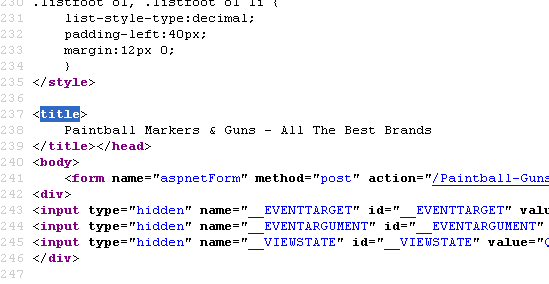 Does the location of the title tag, meta tags, and any structured data have any influence with respect to SEO and search engines? Put another way, could we benefit from moving the title tag up to the top?
I "surfed 'n surfed" and could not find any articles about this.
I would really appreciate any help on this as our site got decimated organically last May and we are looking for any help with SEO.
NIck
0
Does the location of the title tag, meta tags, and any structured data have any influence with respect to SEO and search engines? Put another way, could we benefit from moving the title tag up to the top?
I "surfed 'n surfed" and could not find any articles about this.
I would really appreciate any help on this as our site got decimated organically last May and we are looking for any help with SEO.
NIck
0 -

Blocked URL parameters can still be crawled and indexed by google?
Hy guys, I have two questions and one might be a dumb question but there it goes. I just want to be sure that I understand: IF I tell webmaster tools to ignore an URL Parameter, will google still index and rank my url? IS it ok if I don't append in the url structure the brand filter?, will I still rank for that brand? Thanks, PS: ok 3 questions :)...
Technical SEO | | catalinmoraru0 -

How to search HTML source for an entire website
Is there a way for me to do a "view source" for an entire website without having to right-click every page and select "view source" for each of them?
Technical SEO | | SmartWebPros0 -

Blocking URL's with specific parameters from Googlebot
Hi, I've discovered that Googlebot's are voting on products listed on our website and as a result are creating negative ratings by placing votes from 1 to 5 for every product. The voting function is handled using Javascript, as shown below, and the script prevents multiple votes so most products end up with a vote of 1, which translates to "poor". How do I go about using robots.txt to block a URL with specific parameters only? I'm worried that I might end up blocking the whole product listing, which would result in de-listing from Google and the loss of many highly ranked pages. DON'T want to block: http://www.mysite.com/product.php?productid=1234 WANT to block: http://www.mysite.com/product.php?mode=vote&productid=1234&vote=2 Javacript button code: onclick="javascript: document.voteform.submit();" Thanks in advance for any advice given. Regards,
Technical SEO | | aethereal
Asim0