Moz Q&A is closed.
After more than 13 years, and tens of thousands of questions, Moz Q&A closed on 12th December 2024. Whilst we’re not completely removing the content - many posts will still be possible to view - we have locked both new posts and new replies. More details here.
Desktop & Mobile XML Sitemap Submitted But Only Desktop Sitemap Indexed On Google Search Console
-
Hi!
The Problem
We have submitted to GSC a sitemap index. Within that index there are 4 XML Sitemaps. Including one for the desktop site and one for the mobile site. The desktop sitemap has 3300 URLs, of which Google has indexed (according to GSC) 3,000 (approx). The mobile sitemap has 1,000 URLs of which Google has indexed 74 of them.
The pages are crawlable, the site structure is logical. And performing a Landing Page URL search (showing only Google/Organic source/medium) on Google Analytics I can see that hundreds of those mobile URLs are being landed on. A search on mobile for a longtail keyword from a (randomly selected) page shows a result in the SERPs for the mobile page that judging by GSC has not been indexed.
Could this be because we have recently added rel=alternate tags on our desktop pages (and of course corresponding canonical ones on mobile). Would Google then 'not index' rel=alternate page versions?
Thanks for any input on this one.
-
Hi Allison, any updates on this?
From my understanding, it is possible that Google is not indexing the mobile versions of pages if they are simply corresponding to the desktop pages (and indicated as such with the rel=alternate mobile switchboard tags). If they have that information they may simply index the desktop pages and then display the mobile URL in search results.
It is also possible that the GSC data is not accurate - if you do a 'site:' search for your mobile pages (I would try something like 'site:domain/m/' and see what shows up), does it show a higher number of mobile pages than what you're seeing in GSC?
Can you check data for your mobile rankings and see what URLs are being shown for mobile searchers? If your data is showing that mobile users are landing on these pages from search, this would indicate that they are being shown in search results, even if they're not showing up as "indexed" in GSC.
-
Apologies on the delayed reply and thank you for providing this information!
Has there been any change in this trend over the last week? I do know that subfolder mobile sites are generally not recommended by search engines. That being said, I do not feel the mobile best practice would change as a result. Does the site automatically redirect the user based on their device? If so, be sure Google is redirecting appropriately as well.
"When a website is configured to serve desktop and mobile browsers using different URLs, webmasters may want to automatically redirect users to the URL that best serves them. If your website uses automatic redirection, be sure to treat all Googlebots just like any other user-agent and redirect them appropriately."
Here is Google's documentation on best practices for mobile sites with separate URLs. I do believe the canonical and alternate tags should be left in place. It may be worth experimenting with the removal of these mobile URLs from the sitemap though I feel this is more of a redundancy issue than anything.
I would also review Google's documentation on 'Common Mobile Mistakes', perhaps there is an issue that is restricting search engines from crawling the mobile site efficiently.
Hope that helps!
-
Hi Paul and Joe
Thanks for the reply!
Responsive is definitely in the works...
In the meantime to answer:
-
GSC is setup for the mobile site. However its not on a subdomain, its a subdirectory mobile site. So rather than m.site.com we have www.site.com/m for the mobile sites. A sitemap has been submitted and thats where I can see the data as shown in the image.
-
Because the mobile site is a subdirectory site the data becomes a little blended with the main domain data in Google Search Console. If I want to see Crawl Stats for example Google advises "To see stats and diagnostic information, view the data for (https://www.site.com/)."
-
re: "My recommendation is to remove the XML sitemap and rely on the rel=alternate/canonical tags to get the mobile pages indexed. Google's John Mueller has stated that you do not need a mobile XML sitemap file." I had read this previously, but due to the nature of the sub-directory setup of the site, the mobile sitemap became part of the sitemap index...rather than having just one large sitemap.
Thoughts?
-
-
ASs joe says - set up a separate GSC profile for the mdot subdomain. The use that to submit the mdot sitemap directly if you wish. You'll get vastly better data about the performance of the mdot site by having it split out, instead of mixed into and obfuscated by the desktop data.
Paul
-
Hi Alison,
While this is a bit late, I would recommend moving to a responsive site when/if possible. Much easier to manage, fewer issues with search engines.
My recommendation is to remove the XML sitemap and rely on the rel=alternate/canonical tags to get the mobile pages indexed. Google's John Mueller has stated that you do not need a mobile XML sitemap file.
Also, do you have Google Search Console set up for both the m. mobile site and the desktop version? It does not seem so with all sitemaps listed in the one property in your screenshot. If not, I recommend setting this up as you may receive some valuable insights into how Google is crawling the mobile site.
I'd also review Google's Common Mobile Mistakes guide to see if any of these issues could be impacting your situation. Hope this helps!




Got a burning SEO question?
Subscribe to Moz Pro to gain full access to Q&A, answer questions, and ask your own.
Browse Questions
Explore more categories
-
Moz Tools
Chat with the community about the Moz tools.
-
SEO Tactics
Discuss the SEO process with fellow marketers
-
Community
Discuss industry events, jobs, and news!
-
Digital Marketing
Chat about tactics outside of SEO
-
Research & Trends
Dive into research and trends in the search industry.
-
Support
Connect on product support and feature requests.
Related Questions
-

Google not Indexing images on CDN.
My URL is: https://bit.ly/2hWAApQ We have set up a CDN on our own domain: https://bit.ly/2KspW3C We have a main xml sitemap: https://bit.ly/2rd2jEb and https://bit.ly/2JMu7GB is one the sub sitemaps with images listed within. The image sitemap uses the CDN URLs. We verified the CDN subdomain in GWT. The robots.txt does not restrict any of the photos: https://bit.ly/2FAWJjk. Yet, GWT still reports none of our images on the CDN are indexed. I ve followed all the steps and still none of the images are being indexed. My problem seems similar to this ticket https://bit.ly/2FzUnBl but however different because we don't have a separate image sitemap but instead have listed image urls within the sitemaps itself. Can anyone help please? I will promptly respond to any queries. Thanks
Technical SEO | | TNZ
Deepinder0 -

Robots.txt & meta noindex--site still shows up on Google Search
I have set up my robots.txt like this: User-agent: *
Technical SEO | | RoxBrock
Disallow: / and I have this meta tag in my on a Wordpress site, set up with SEO Yoast name="robots" content="noindex,follow"/> I did "Fetch as Google" on my Google Search Console My website is still showing up in the search results and it says this: "A description for this result is not available because of this site's robots.txt" This site has not shown up for years and now it is ranking above my site that I want to rank for this keyword. How do I get Google to ignore this site? This seems really weird and I'm confused how a site with little content, that has not been updated for years can rank higher than a site that is constantly updated and improved.1 -

301 Redirects Relating to Your XML Sitemap
Lets say you've got a website and it had quite a few pages that for lack of a better term were like an infomercial, 6-8 pages of slightly different topics all essentially saying the same thing. You could all but call it spam. www.site.com/page-1 www.site.com/page-2 www.site.com/page-3 www.site.com/page-4 www.site.com/page-5 www.site.com/page-6 Now you decided to consolidate all of that information into one well written page, and while the previous pages may have been a bit spammy they did indeed have SOME juice to pass through. Your new page is: www.site.com/not-spammy-page You then 301 redirect the previous 'spammy' pages to the new page. Now the question, do I immediately re-submit an updated xml sitemap to Google, which would NOT contain all of the old URL's, thus making me assume Google would miss the 301 redirect/seo juice. Or do I wait a week or two, allow Google to re-crawl the site and see the existing 301's and once they've taken notice of the changes submit an updated sitemap? Probably a stupid question I understand, but I want to ensure I'm following the best practices given the situation, thanks guys and girls!
Technical SEO | | Emory_Peterson0 -

Redirecting old Sitemaps to a new XML
I've discovered a ton of 404s from Google's WMT crawler looking for mydomain.com/sitemap_archive_MONTH_YEAR. There are tons of these monthly archive xmls. I've used a plugin that for some reason created individual monthly archive xml sitemaps and now I get 404s. Creating rules for each archive seems a bad solution. My current sitemap plugin creates a single clean one mydomain.com/sitemap_index.xml. How can I create a redirect rule in the Redirection WP plugin that will redirect any URL that has the 'sitemap' and 'xml' string in it to my current xml sitemap? I've tried using a wildcard like so: mysite.com/sitemap*.*, mysite.com/sitemap ., mysite.com/sitemap(.), mysite.com/sitemap (.) but none of the wildcard uses got the general redirect to work. Is there a way to make this happen with the WP Redirection plugin? If not, is there a htaccess rule, and what would the code be for it? Im not very fluent with using general redirects in htaccess unfortunately. Thanks!
Technical SEO | | IgorMateski0 -
Image Indexing Issue by Google
Hello All,My URL is: www.thesalebox.comI have Submitted my image Sitemap in google webmaster tool on 10th Oct 2013,Still google could not indexing any of my web images,Please refer my sitemap - www.thesalebox.com/AppliancesHomeEntertainment.xml and www.thesalebox.com/Hardware.xmland my webmaster status and image indexing status are below,
Technical SEO | | CommercePundit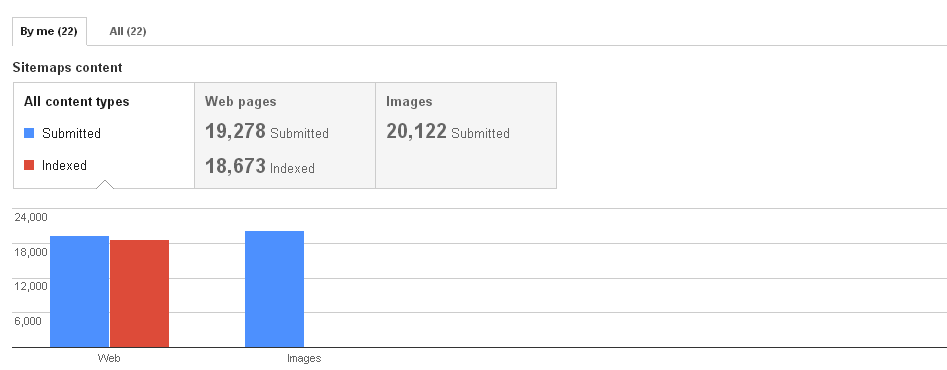 Can you please help me, why my images are not indexing in google yet? is there any issue? please give me suggestions?Thanks!
0
Can you please help me, why my images are not indexing in google yet? is there any issue? please give me suggestions?Thanks!
0 -

How to Stop Google from Indexing Old Pages
We moved from a .php site to a java site on April 10th. It's almost 2 months later and Google continues to crawl old pages that no longer exist (225,430 Not Found Errors to be exact). These pages no longer exist on the site and there are no internal or external links pointing to these pages. Google has crawled the site since the go live, but continues to try and crawl these pages. What are my next steps?
Technical SEO | | rhoadesjohn0 -

Removing Redirected URLs from XML Sitemap
If I'm updating a URL and 301 redirecting the old URL to the new URL, Google recommends I remove the old URL from our XML sitemap and add the new URL. That makes sense. However, can anyone speak to how Google transfers the ranking value (link value) from the old URL to the new URL? My suspicion is this happens outside the sitemap. If Google already has the old URL indexed, the next time it crawls that URL, Googlebot discovers the 301 redirect and that starts the process of URL value transfer. I guess my question revolves around whether removing the old URL (or the timing of the removal) from the sitemap can impact Googlebot's transfer of the old URL value to the new URL.
Technical SEO | | RyanOD0 -

Can you have a /sitemap.xml and /sitemap.html on the same site?
Thanks in advance for any responses; we really appreciate the expertise of the SEOmoz community! My question: Since the file extensions are different, can a site have both a /sitemap.xml and /sitemap.html both siting at the root domain? For example, we've already put the html sitemap in place here: https://www.pioneermilitaryloans.com/sitemap Now, we're considering adding an XML sitemap. I know standard practice is to load it at the root (www.example.com/sitemap.xml), but am wondering if this will cause conflicts. I've been unable to find this topic addressed anywhere, or any real-life examples of sites currently doing this. What do you think?
Technical SEO | | PioneerServices0
