Moz Q&A is closed.
After more than 13 years, and tens of thousands of questions, Moz Q&A closed on 12th December 2024. Whilst we’re not completely removing the content - many posts will still be possible to view - we have locked both new posts and new replies. More details here.
Google My Business- Will a large service area dilute local search results?
-
I am considering adding our actual service area to our Google My Business profile, but I don't want this to dilute our local search results. As it is, we come up in the top 3 or so when searched in our HQ's city and several nearby cities when you search for us in Google Maps (although when I look at the top 10 organic for Google for some reason when you search for these cities + our keywords Google doesn't show any local results).
Our actual service area is fairly large, comprising the states of CA & Hawaii & parts of CO, AZ, and UT. I would be adding the service area by zip code rather than radius, as a radius wouldn't make any sense in this case (particularly considering the distance between HI and CA). Is it better to keep our relatively high ranking in local results? Will adding the service area not affect local results negatively?
Also, do you know why Google isn't showing me local results when I look for our keywords + our nearby cities? When I look for these keywords in larger cities like LA or San Diego, Google always shows me local results.
-
Hey Brett!
There are some nuances to this I want to be sure I'm understanding.
-
How many physical locations do you have? Are you saying that you have 1 physical location from which you are serving all of those states, or do you have physical locations in each of the states?
-
Are you meeting face-to-face with your customers in each of these states, either at your office or at their homes/businesses?
Please, answer these 2 questions as fully as possible.
Regarding instances in which Google does not show local results for a given query, this is based on their internal interpretation of what is most relevant. Google makes a decision about whether a searcher's intent is local or not, and also, they determine whether there is enough relevant local data to show on a given query. No one (but Google) knows all of the ins and outs of these decisions, but it's not something you can really influence. The important thing is to recognize whether Google is showing local or organic results for your core queries and then do everything you can to become dominant in those results, either via local or traditional marketing methods. Remember, too, that results are personalized - so you searching from Hawaii are not seeing the same results that your customer is searching from California

I'll look forward to your replies on questions 1 & 2.
-
-
Hi Brett. The biggest changes that you'll want to address / consider when working on this come from last July's Penguin update: http://moz.rainyclouds.online/google-algorithm-change (see: Penguin - July 24, 2014). Mainly that, "Google has released a new algorithm to provide a more useful, relevant and accurate local search results that are tied more closely to traditional web search ranking signals." It sounds like you'll want to create content on your site that does as well traditionally as your HQ content for: CA, Hawaii, CO, AZ, and UT. This will help spur your localized results on as well.
More in-depth on the disappearance, check: http://blumenthals.com/blog/2014/07/25/google-updates-local-algo-with-more-web-based-signals-turmoil-in-serps/, "In searches I follow there has been both ups, downs and the disappearance of the pack where it was previously prominent. In one case a detached listing which had been doing well both organically and locally but wasn’t in the pack returned to the pack."
It's likely your current listings will stay as long as you don't nuke content on your site. The addition of service areas else where matching additional content on site would be a natural fit. Cheers!



Got a burning SEO question?
Subscribe to Moz Pro to gain full access to Q&A, answer questions, and ask your own.
Browse Questions
Explore more categories
-
Moz Tools
Chat with the community about the Moz tools.
-
SEO Tactics
Discuss the SEO process with fellow marketers
-
Community
Discuss industry events, jobs, and news!
-
Digital Marketing
Chat about tactics outside of SEO
-
Research & Trends
Dive into research and trends in the search industry.
-
Support
Connect on product support and feature requests.
Related Questions
-

Google My Business - Service Area - Use Zip Codes or City Names?
Google allows you to choose up to 20 locations as service areas, and you can choose based on cities, counties, or zip codes. I'm trying to determine if zip codes, cities, or counties are better to select for our GMB profiles. We are located in the US. I am thinking it's best to use all 20 areas allowed on a profile as long as they are relevant, generally giving Google all the info they will let you provide is best. I also am leaning toward using zip codes because it also includes the city when you choose by zip code. For example: Entered the zip code 21009 and the service area selection provided was: Abingdon, MD 21009, USA Entering the city/state returns a selection of Abingdon, MD, USA I also think it may have to do with how people search and find your business as well? Does anyone have experience with this? Best practices? My google searching has not turned up any reliable info.
Local Listings | | WadeBayMgmt0 -

Google Business Listing with no physical office location
Hey, everyone! As a business owner who works from home and doesn't have a physical office location. Is setting up a Google business listing without location going to hurt my local search ranking? Should I get a virtual office so I have a physical location? Thank you!! 😃
Local Listings | | ichorstudios0 -

Where does the small description on a business listing come from in google maps?
Hi All, Simple question, but I'm struggling to find the answer, so I hope someone is able to help. The business I run is Oakdene Forest Park; Google Maps URL: https://www.google.com/maps/place/Oakdene™+Forest+Park/@50.8114372,-1.8598721,18z/data=!4m12!1m6!3m5!1s0x4873980ce90e4ef7:0x755579d631c25b33!2sOakdene™+Forest+Park!8m2!3d50.8114796!4d-1.8582842!3m4!1s0x4873980ce90e4ef7:0x755579d631c25b33!8m2!3d50.8114796!4d-1.8582842?hl=en Under the business name, it has a small description and for the life of me I don't know where Google is getting it from because a part of it is wrong. It looks like this: Oakdene™ Forest Park Rural Resort with Entertainment & a Spa I would like to remove the term 'Rural Resort' but where do I find it?? Thanks in advance for your help.
Local Listings | | Shorefield_Holidays0 -

Improve Google Business ranking
While my client's websites have been ranking well in SERP for their keyterms I'm at a lost on what I can do to improve their Google business/map presence. I'm referring to their listing where the top three come up or when you search on Google Maps.
Local Listings | | FPK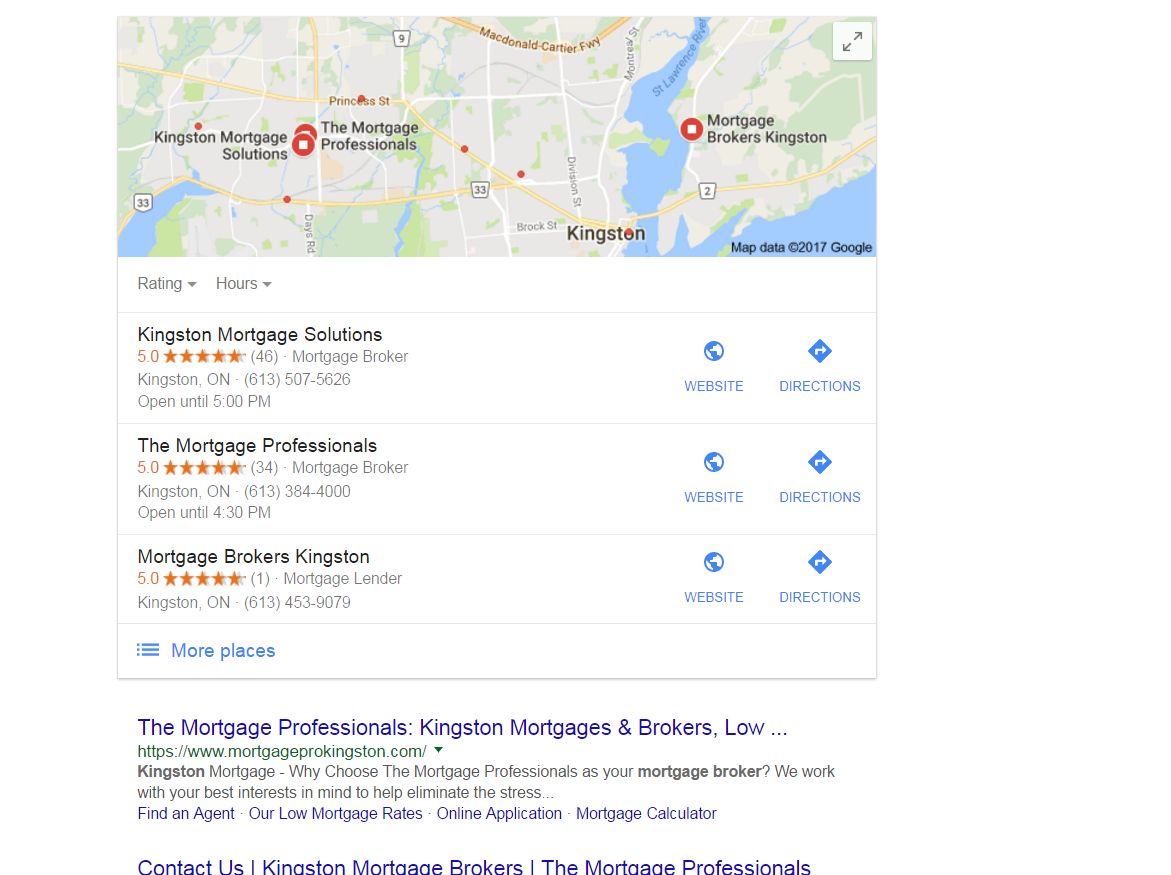
https://gyazo.com/26ec78ed7f712157ec72492199545431 Ex 1. Several months ago my client was ranked #1 both for SERP and maps until they dropped to 2nd on maps. Now they're ranked 1st in search yet 2nd for local business rankings as you can see from the screenshot above. At one point my client's business did have more reviews than the 1st ranking business yet they still weren't 1st. Ex. 2. Client(s) is ranked 4th in search and doesn't show in the top 3 map listings for their search term. If you click on More places to view Google Maps they're listed all the way down as the 15th listing or worse can't even be found when searching by their main SEO key term . Of course they are found by searching for their business name so it's not like there is a problem with the listing. I make sure to: Completely fill out their Google Business profile(NAP, hours and add pictures) Have my client try to gain positive reviews Manage and respond to reviews(mainly the negative ones) Add map and Google business link to their website Can anyone offer any other insight on what else can be done to improve their local presence on maps that I might be missing?0 -

Disadvantages to Hiding Business Address on Google Places?
From a Local SEO standpoint, wouldn't hiding a business address on Google Places for Business create an SEO disadvantage in that I would expect in the local portion of the search results, there would be a bias to showing businesses that have not hidden their address as then you can place a pin on the map at the location? Or from a Local SEO standpoint does it not matter if you hide your address or not?
Local Listings | | Jazee1 -

Scoot local links
I've been approached from Scoot trying to sell me their local directory links.
Local Listings | | LaurenGT
Its a one-off price of around £80 to be listed on all of their 500+ directories and £20 a month to be able to do any changes and to keep the web links active.
The list of the directories are here - http://submittrackz.scoot.co.uk/directories The question is, are the links of much benefit for local seo?
I was thinking of reselling this so the cost is not the problem so much, its just the quality of the links in question.
Thanks
Dave0 -

Local Search and Schema.org - Do I need to tag up the "same as" Property to all my citations to help with local rankings?
Hi All, We have implemented Schema.og on our website and this also includes the local business schema for all of our branches.However I've read an article (see below ) which says we should also be doing "same as " property and linking this to ALL of our citations such as google plus page , yelp , bing places, city search etc etc as this will help with citations. I am wondering if anyone has done this ? - And if so , has this helped with local rankings etc - I don't really want to invest the extra costs to get this done if I can't find anywhere that says its made a difference - The article from whitespark - says - "when you create new citations for your business (or for your client’s), it’s a waiting game hoping that Google and the other search engines will find your new citations quickly and make the connection between those listings, the business, and the website. The “sameAs” property can help make that process much quicker _and _easier. Schema.org explains that the “sameAs” property is used along with the “URL of a reference Web page that unambiguously indicates the item's [or business’] identity.” By using the “sameAs” property in your NAP schema markup, you can tell search engines that the business you’ve marked up is the same one found at a certain citation URL Of course, Google+ isn’t the only important citation source. There’s also Bing Places, Facebook, Yelp, Citysearch and a few others. The nice thing about many schema.org properties is that you can use them multiple times in your markup." I am wondering what peoples thoughts were and whether they has implemented this and if so , did it help ? thanks Pete | [sameAs](http://schema.org/sameAs) | URL | URL of a reference Web page that unambiguously indicates the item's identity. E.g. the URL of the item's Wikipedia page, Freebase page, or official website. |
Local Listings | | PeteC121 -
Should my website link to my google business listing given that I already link from google business to my website ?
I have a website with individual Location Landing Pages for each of my Depots. I also have individual Google Local Business Listings for each of my depots. Should I have a link from my Website Location Landing Pages to the associated Google local Business listings or not ?... Given that I already have a link on my Google Business listing to the relevant Location Page on my website. I wasn't sure whether linking both ways would be more beneficial thus enforcing things better or whether it's not needed to link both ways . thanks Pete
Local Listings | | PeteC120