Moz Q&A is closed.
After more than 13 years, and tens of thousands of questions, Moz Q&A closed on 12th December 2024. Whilst we’re not completely removing the content - many posts will still be possible to view - we have locked both new posts and new replies. More details here.
Does it hurt to have a dynamic counter in your page title?
-
Currently we work with page titles which display the number of products we have as a counter. This number is highly volatile and can change every day, so that our page title changes all the time. We did this to improve user experience, meet expectations and improve click through rates. Question is whether this can hurt our rankings and if someone has experimented with this or has experience with this?
-
I've got a site with something similar in the home page title tag and there are not problems at all getting that site to rank on fairly competitive terms. Whether it would rank better without that is hard to say. Ours changes only once or twice a week though, although I don't imagine that makes a difference.
However, it has helped our click through rates - which means more traffic. Traffic is the aim, so I'm happy with that.
My only concern would be whether it impacts bounce rate. If the thing being counted is a key part of the decision and people click through and see something different (because the cached version is out of date) that might have an effect. Pretty easy to measure that though.


Got a burning SEO question?
Subscribe to Moz Pro to gain full access to Q&A, answer questions, and ask your own.
Browse Questions
Explore more categories
-
Moz Tools
Chat with the community about the Moz tools.
-
SEO Tactics
Discuss the SEO process with fellow marketers
-
Community
Discuss industry events, jobs, and news!
-
Digital Marketing
Chat about tactics outside of SEO
-
Research & Trends
Dive into research and trends in the search industry.
-
Support
Connect on product support and feature requests.
Related Questions
-

How to add titles to Pardot landing pages
I have 5 URLs that are "missing titles" however, all 5 are landing pages that were created in Pardot. how would I go about adding the missing title? Would I need to add it on our website platform or in Pardot?
Technical SEO | | cbriggs0 -

Home Page Ranking Instead of Service Pages
Hi everyone! I've noticed that many of our clients have pages addressing specific queries related to specific services on their websites, but that the Home Page is increasingly showing as the "ranking" page. For example, a plastic surgeon we work with has a page specifically talking about his breast augmentation procedure for Miami, FL but instead of THAT page showing in the search results, Google is using his home page. Noticing this across the board. Any insights? Should we still be optimizing these specific service pages? Should I be spending time trying to make sure Google ranks the page specifically addressing that query because it SHOULD perform better? Thanks for the help. Confused SEO :/, Ricky Shockley
Technical SEO | | RickyShockley0 -

Why is Google Webmaster Tools showing 404 Page Not Found Errors for web pages that don't have anything to do with my site?
I am currently working on a small site with approx 50 web pages. In the crawl error section in WMT Google has highlighted over 10,000 page not found errors for pages that have nothing to do with my site. Anyone come across this before?
Technical SEO | | Pete40 -

Does Title Tag location in a page's source code matter?
Currently our meta description is on line 8 for our page - http://www.paintball-online.com/Paintball-Guns-And-Markers-0Y.aspx
Technical SEO | | Istoresinc The title tag, however sits below a bunch of code on line 237
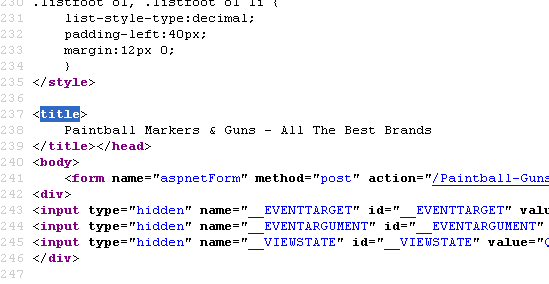 Does the location of the title tag, meta tags, and any structured data have any influence with respect to SEO and search engines? Put another way, could we benefit from moving the title tag up to the top?
I "surfed 'n surfed" and could not find any articles about this.
I would really appreciate any help on this as our site got decimated organically last May and we are looking for any help with SEO.
NIck
0
Does the location of the title tag, meta tags, and any structured data have any influence with respect to SEO and search engines? Put another way, could we benefit from moving the title tag up to the top?
I "surfed 'n surfed" and could not find any articles about this.
I would really appreciate any help on this as our site got decimated organically last May and we are looking for any help with SEO.
NIck
0 -

How Does Google's "index" find the location of pages in the "page directory" to return?
This is my understanding of how Google's search works, and I am unsure about one thing in specific: Google continuously crawls websites and stores each page it finds (let's call it "page directory") Google's "page directory" is a cache so it isn't the "live" version of the page Google has separate storage called "the index" which contains all the keywords searched. These keywords in "the index" point to the pages in the "page directory" that contain the same keywords. When someone searches a keyword, that keyword is accessed in the "index" and returns all relevant pages in the "page directory" These returned pages are given ranks based on the algorithm The one part I'm unsure of is how Google's "index" knows the location of relevant pages in the "page directory". The keyword entries in the "index" point to the "page directory" somehow. I'm thinking each page has a url in the "page directory", and the entries in the "index" contain these urls. Since Google's "page directory" is a cache, would the urls be the same as the live website (and would the keywords in the "index" point to these urls)? For example if webpage is found at wwww.website.com/page1, would the "page directory" store this page under that url in Google's cache? The reason I want to discuss this is to know the effects of changing a pages url by understanding how the search process works better.
Technical SEO | | reidsteven750 -

Determining When to Break a Page Into Multiple Pages?
Suppose you have a page on your site that is a couple thousand words long. How would you determine when to split the page into two and are there any SEO advantages to doing this like being more focused on a specific topic. I noticed the Beginner's Guide to SEO is split into several pages, although it would concentrate the link juice if it was all on one page. Suppose you have a lot of comments. Is it better to move comments to a second page at a certain point? Sometimes the comments are not super focused on the topic of the page compared to the main text.
Technical SEO | | ProjectLabs1 -

Can dynamically translated pages hurt a site?
Hi all...looking for some insight pls...i have a site we have worked very hard on to get ranked well and it is doing well in search. The site has about 1000 pages and climbing and has about 50 of those pages in translated pages and are static pages with unique urls. I have had no problems here with duplicate content and that sort of thing and all pages were manually translated so no translation issues. We have been looking at software that can dynamically translate the complete site into a handfull of languages...lets say about 5. My problem here is these pages get produced dynamically and i have concerns that google will take issue with this aswell as the huge sudden influx of new urls....as now we could be looking at and increase of 5000 new urls. (which usually triggers an alarm) My feeling is that it could be risking the stability of the site that we have worked so hard for and maybe just stick with the already translated static pages. I am sure the process could be fine but fear a manual inspection and a slap on the wrist for having dynamically created content?? and also just risk a review trigger period. These days it is hard to know what could get you in "trouble" and my gut says keep it simple and as is and dont shake it up?? Am i being overly concerned? Would love to here from others who have tried similar changes and also those who have not due to similar "fear" thanks
Technical SEO | | nomad-2023230 -

How should I shorten my titles?
I've read that page titles can't/shouldn't be more than 70 characters long. Out of around 1,000 products we have about 150 that have legitimate titles that exceed this character limitation. We plan on automatically truncating these. Should I just cut the titles off at 70 characters or should I cut them off and add a "..."? Does it even matter?
Technical SEO | | dbuckles0