Moz Q&A is closed.
After more than 13 years, and tens of thousands of questions, Moz Q&A closed on 12th December 2024. Whilst we’re not completely removing the content - many posts will still be possible to view - we have locked both new posts and new replies. More details here.
What's the best way to test Angular JS heavy page for SEO?
-
Hi Moz community,
Our tech team has recently decided to try switching our product pages to be JavaScript dependent, this includes links, product descriptions and things like breadcrumbs in JS. Given my concerns, they will create a proof of concept with a few product pages in a QA environment so I can test the SEO implications of these changes. They are planning to use Angular 5 client side rendering without any prerendering. I suggested universal but they said the lift was too great, so we're testing to see if this works.
I've read a lot of the articles in this guide to all things SEO and JS and am fairly confident in understanding when a site uses JS and how to troubleshoot to make sure everything is getting crawled and indexed.
https://sitebulb.com/resources/guides/javascript-seo-resources/
However, I am not sure I'll be able to test the QA pages since they aren't indexable and lives behind a login. I will be able to crawl the page using Screaming Frog but that's generally regarded as what a crawler should be able to crawl and not really what Googlebot will actually be able to crawl and index.
Any thoughts on this, is this concern valid?
Thanks!
-
Hi Zack,
I think your concern here is valid (your render with Screaming Frog or any other client is unlikely to be precisely representative of what Googlebot will see/index). That said, I'm not sure there's much you can do to eliminate this knowledge gap for your QA process.
For instance, while we have seen Googlebot timing out JS rendering around the ~5s mark using the "Fetch & Render as Googlebot" functionality in Search Console (see slide 25 of Max Prin's slide deck here), there's no confirmation this time limit represents Googlebot's behavior in the wild.
Additionally, we know that Googlebot crawls with limited JS support - for instance, when a script uses JS to generate a random number, my colleague Tom Anthony found that Googlebot's random() JS function is deterministic (returns a predictable set) - so it's clear they have modified the headless version of Chrome they use to conserve computational expenses in this way. We can only assume they've taken other steps to save computing costs. This isn't baked-into Screaming Frog or any other crawling tool.
We have seen that with a 5s timeout set in Screaming Frog, the rendered result is pretty close to what "Fetch & Render as Googlebot" functionality demonstrates. And with the ubiquity of JS-driven content on the web today, provided links and content are rendered into the DOM fairly quickly (well ahead of that 5s mark), we've seen Google rendering and indexing JS content fairly reliable.
The ideal would be for your dev team to code these pages to degrade gracefully - so that even with JS support totally disabled, navigation and content elements are still rendered (they should be delivered in the page source, then enhanced with JS, if possible).
Failing that, the best you're likely to achieve here is reasonable confident that Googlebot can crawl, render and index these pages - there'll be some risk when you publish them to production.
Hope this helps somewhat - best of luck!
Thanks,
Mike


Got a burning SEO question?
Subscribe to Moz Pro to gain full access to Q&A, answer questions, and ask your own.
Browse Questions
Explore more categories
-
Moz Tools
Chat with the community about the Moz tools.
-
SEO Tactics
Discuss the SEO process with fellow marketers
-
Community
Discuss industry events, jobs, and news!
-
Digital Marketing
Chat about tactics outside of SEO
-
Research & Trends
Dive into research and trends in the search industry.
-
Support
Connect on product support and feature requests.
Related Questions
-

Shopify SEO - Double Filter Pages
Hi Experts, Single filter page: /collections/dining-chairs/black
Technical SEO | | williamhuynh
-- currently, canonical the same: /collections/dining-chairs/black
-- currently, index, follow Double filter page: /collections/dining-chairs/black+fabric
-- currently, canonical the same: /collections/dining-chairs/black+fabric
-- currently, noindex, follow My question is about double filter page above:
if noindexing is the better option OR should I change the canonical to /collections/dining-chairs/black Thank you0 -

Spam URL'S in search results
We built a new website for a client. When I do 'site:clientswebsite.com' in Google it shows some of the real, recently submitted pages. But it also shows many pages of spam url results, like this 'clientswebsite.com/gockumamaso/22753.htm' - all of which then go to the sites 404 page. They have page titles and meta descriptions in Chinese or Japanese too. Some of the urls are of real pages, and link to the correct page, despite having the same Chinese page titles and descriptions in the SERPS. When I went to remove all the spammy urls in Search Console (it only allowed me to temporarily hide them), a whole load of new ones popped up in the SERPS after a day or two. The site files itself are all fine, with no errors in the server logs. All the usual stuff...robots.txt, sitemap etc seems ok and the proper pages have all been requested for indexing and are slowly appearing. The spammy ones continue though. What is going on and how can I fix it?
Technical SEO | | Digital-Murph0 -

Soft 404's on a 301 Redirect...Why?
So we launched a site about a month ago. Our old site had an extensive library of health content that went away with the relaunch. We redirected this entire section of the site to the new education materials, but we've yet to see this reflected in the index or in GWT. In fact, we're getting close to 500 soft 404's in GWT. Our development team confirmed for me that the 301 redirect is configured correctly. Is it just a waiting game at this point or is there something I might be missing? Any help is appreciated. Thanks!
Technical SEO | | MJTrevens0 -

Should I disavow links from pages that don't exist any more
Hi. Im doing a backlinks audit to two sites, one with 48k and the other with 2M backlinks. Both are very old sites and both have tons of backlinks from old pages and websites that don't exist any more, but these backlinks still exist in the Majestic Historic index. I cleaned up the obvious useless links and passed the rest through Screaming Frog to check if those old pages/sites even exist. There are tons of link sending pages that return a 0, 301, 302, 307, 404 etc errors. Should I consider all of these pages as being bad backlinks and add them to the disavow file? Just a clarification, Im not talking about l301-ing a backlink to a new target page. Im talking about the origin page generating an error at ping eg: originpage.com/page-gone sends me a link to mysite.com/product1. Screamingfrog pings originpage.com/page-gone, and returns a Status error. Do I add the originpage.com/page-gone in the disavow file or not? Hope Im making sense 🙂
Technical SEO | | IgorMateski0 -

Does Title Tag location in a page's source code matter?
Currently our meta description is on line 8 for our page - http://www.paintball-online.com/Paintball-Guns-And-Markers-0Y.aspx
Technical SEO | | Istoresinc The title tag, however sits below a bunch of code on line 237
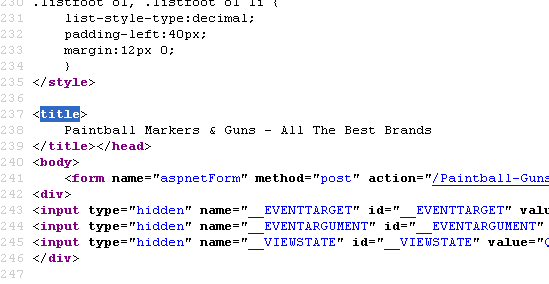 Does the location of the title tag, meta tags, and any structured data have any influence with respect to SEO and search engines? Put another way, could we benefit from moving the title tag up to the top?
I "surfed 'n surfed" and could not find any articles about this.
I would really appreciate any help on this as our site got decimated organically last May and we are looking for any help with SEO.
NIck
0
Does the location of the title tag, meta tags, and any structured data have any influence with respect to SEO and search engines? Put another way, could we benefit from moving the title tag up to the top?
I "surfed 'n surfed" and could not find any articles about this.
I would really appreciate any help on this as our site got decimated organically last May and we are looking for any help with SEO.
NIck
0 -

What is the best way to deal with an event calendar
I have an event calendar that has multiple repeating items into the future. They are classes that typically all have the same titles but will occasionally have different information. I don't know what is the best way to deal with them and am open to suggestions. Currently Moz anayltics is showing multiple errors (duplicate page titles, descriptions and overly dynamic urls). I'm assuming that it's showing duplicate elements way into the future. I thought of having the calendar no followed at all but the content for the classes seems valuable. Thanks,
Technical SEO | | categorycode0 -

Best Practices for adding Dynamic URL's to XML Sitemap
Hi Guys, I'm working on an ecommerce website with all the product pages using dynamic URL's (we also have a few static pages but there is no issue with them). The products are updated on the site every couple of hours (because we sell out or the special offer expires) and as a result I keep seeing heaps of 404 errors in Google Webmaster tools and am trying to avoid this (if possible). I have already created an XML sitemap for the static pages and am now looking at incorporating the dynamic product pages but am not sure what is the best approach. The URL structure for the products are as follows: http://www.xyz.com/products/product1-is-really-cool
Technical SEO | | seekjobs
http://www.xyz.com/products/product2-is-even-cooler
http://www.xyz.com/products/product3-is-the-coolest Here are 2 approaches I was considering: 1. To just include the dynamic product URLS within the same sitemap as the static URLs using just the following http://www.xyz.com/products/ - This is so spiders have access to the folder the products are in and I don't have to create an automated sitemap for all product OR 2. Create a separate automated sitemap that updates when ever a product is updated and include the change frequency to be hourly - This is so spiders always have as close to be up to date sitemap when they crawl the sitemap I look forward to hearing your thoughts, opinions, suggestions and/or previous experiences with this. Thanks heaps, LW0 -

Found a Typo in URL, what's the best practice to fix it?
Wordpress 3.4, Yoast, Multisite The URL is supposed to be "www.myexample.com/great-site" but I just found that it's "www.myexample.com/gre-atsite" It is a relatively new site but we already pointed several internal links to "www.myexample.com/gre-atsite" What's the best practice to correct this? Which option is more desirable? 1.Creating a new page I found that Yoast has "301 redirect" option in the Advanced tap Can I just create a new page(exact same page) and put noindex, nofollow and redirect it to http://www.myexample.com/great-site OR 2. htacess redirect rule simply change the URL to http://www.myexample.com/great-site and update it, and add Options +FollowSymLinks RewriteEngine On
Technical SEO | | joony2008
RewriteCond %{HTTP_HOST} ^http://www.myexample.com/gre-atsite$ [NC]
RewriteRule ^(.*)$ http://www.myexample.com/great-site$1 [R=301,L]0