Moz Q&A is closed.
After more than 13 years, and tens of thousands of questions, Moz Q&A closed on 12th December 2024. Whilst we’re not completely removing the content - many posts will still be possible to view - we have locked both new posts and new replies. More details here.
Why Product pages are throwing Missing field "image" and Missing field "price" in Wordpress Woocommerce
-
I have a wordpress wocommerce website where I have uploaded 100s of products but it's giving me error in GSC under merchant listing tab. When I tested it show missing field image and missing field price. I have done everything according to https://developers.google.com/search/docs/appearance/structured-data/product#merchant-listing-experiences and applied fixed i.e. images are 800x800 and price range is also there. What else can be done here?!
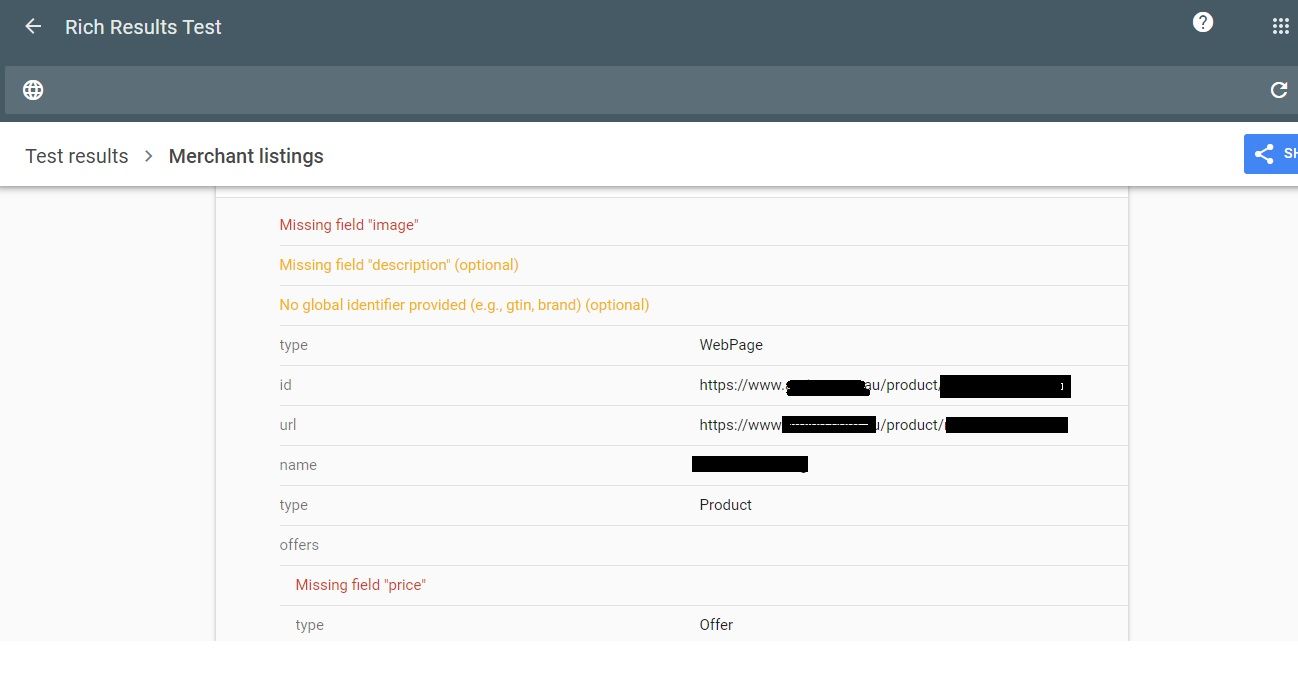
-
The "Missing field 'image' and 'price'" errors in WordPress WooCommerce product pages typically indicate that some product listings are incomplete or lacking essential information. To resolve this, ensure that you have properly configured product images and prices for all your items in the WooCommerce backend. This will help provide a better shopping experience for your customers. If you need more guidance on how to fix these issues, please let me know.
-
Hey, it sounds like there might be a configuration issue with the product pages. Have you checked if the 'image' and 'price' fields are properly Nedbank Branch Code filled for each product in the WooCommerce settings? Double-checking those might solve the problem. Let me know how it goes!
-
I'm sorry to hear about the trouble you're facing. This issue might stem from incomplete product listings in your WooCommerce setup. Ensure that each product has a designated image and price specified. Also, double-check any custom fields or plugins that might affect this. If the problem persists, Nedbank Branch Code reaching out to WooCommerce support or consulting the community forums could provide further assistance. Good luck!
-
I'm sorry to hear about the trouble you're facing. It sounds like you've followed the structured data guidelines correctly. Double-check that there are no typos or discrepancies in your code. Also, ensure your website is properly indexed by Google. If the issue persists, consider reaching out to Google Support for more specific guidance. Good luck getting it sorted!



Got a burning SEO question?
Subscribe to Moz Pro to gain full access to Q&A, answer questions, and ask your own.
Browse Questions
Explore more categories
-
Moz Tools
Chat with the community about the Moz tools.
-
SEO Tactics
Discuss the SEO process with fellow marketers
-
Community
Discuss industry events, jobs, and news!
-
Digital Marketing
Chat about tactics outside of SEO
-
Research & Trends
Dive into research and trends in the search industry.
-
Support
Connect on product support and feature requests.
Related Questions
-

Migrating Subfolder content to New domain Safely
Hello everyone, I'm currently facing a challenging situation and would greatly appreciate your expertise and guidance. I own a website, maniflexa.com, primarily focused on the digital agency niche. About 3 months ago, I created a subfolder, maniflexa.com/emploi/, dedicated to job listings which is a completely different niche. The subfolder has around 120 posts and pages. Unfortunately, since I created the subfolder, the rankings of my main site have been negatively impacted. I was previously ranking #1 for all local digital services keywords, but now, only 2 out of 16 keywords have maintained their positions. Other pages have dropped to positions 30 and beyond. I'm considering a solution and would like your advice: I'm planning to purchase a new domain and migrate the content from maniflexa.com/emploi/ to newdomain.com. However, I want to ensure a smooth migration without affecting the main domain maniflexa.com rankings and losing backlinks from maniflexa.com/emploi/ pages. Is moving the subfolder content to a new domain a viable solution? And how can I effectively redirect all pages from the subfolder to the new domain while preserving page ranks and backlinks?
Intermediate & Advanced SEO | | davidifaso
I wish they did, but GSC doesn't offer a solution to migration content from subfolder to a new domain. 😢 Help a fellow Mozer. Thanks for giving a hand.0 -

Safety Data Sheet PDFs are Showing Higher in Search Results than Product Pages
I have a client who just launched an updated website that has WooCommerce added to it. The website also has a page of Safety Data Sheets that are PDFs that contain information about some of the products. When we do a Google search for many of the products the Safety Data Sheets show up first in the search results instead of the product pages. Has anyone had this happen and know how to solve the issue?
Technical SEO | | teamodea0 -

Unsolved Capturing Source Dynamically for UTM Parameters
Does anyone have a tutorial on how to dynamically capture the referring source to be populated in UTM parameters for Google Analytics? We want to syndicate content and be able to see all of the websites that provided referral traffic for this specific objective. We want to set a specific utm_medium and utm_campaign but have the utm_source be dynamic and capture the referring website. If we set a permanent utm_source, it would appear the same for all incoming traffic. Thanks in advance!
Technical SEO | | peteboyd0 -

Collections or blog posts for Shopify ecommerce seo?
Hi, hope you guys can help as I am going down a rabbit hole with this one! We have a solid-ranking sports nutrition site and are building a new SEO keyword strategy on our Shopify built store. We are using collections (categories) for much of the key product-based seo. This is because, as we understand it, Google prioritises collection/category pages over product pages. Should we then build additional collection pages to rank for secondary product search terms that could fit a collection page structure (eg 'vegan sports nutrition'), or should we use blog posts to do this? We have a quality blog with good unique content and reasonable domain authority so both options are open to us. But while the collection/category option may be best for SEO, too many collections/categories could upset our UX. We have a very small product range (10 products) so want to keep navigation fast and easy. Our 7 lead keyword collection pages do this already. More run the risk of upsetting ease/speed of site navigation. On the other hand, conversion rate from collection pages is historically much better than blog pages. We have made major technical upgrades to the blog to improve this but these are yet to be tested in anger. So at the heart of it all - do you guys recommend favouring blog posts or collection/category pages for secondary high sales intent keywords? All help gratefully received - thanks!
SEO Tactics | | WP332 -

My Website's Home Page is Missing on Google SERP
Hi All, I have a WordPress website which has about 10-12 pages in total. When I search for the brand name on Google Search, the home page URL isn't appearing on the result pages while the rest of the pages are appearing. There're no issues with the canonicalization or meta titles/descriptions as such. What could possibly the reason behind this aberration? Looking forward to your advice! Cheers
Technical SEO | | ugorayan0 -

Non Published Wordpress Pages
Hi, Is there any negative SEO consequences from having too many pages private or not published. Can it like slow the site down or does it not matter? Someone in my dept. has so many pages started/not complete and besides being messy, I wonder if it has any negative impact on the site. Thanks
Technical SEO | | aua1 -

How Does Google's "index" find the location of pages in the "page directory" to return?
This is my understanding of how Google's search works, and I am unsure about one thing in specific: Google continuously crawls websites and stores each page it finds (let's call it "page directory") Google's "page directory" is a cache so it isn't the "live" version of the page Google has separate storage called "the index" which contains all the keywords searched. These keywords in "the index" point to the pages in the "page directory" that contain the same keywords. When someone searches a keyword, that keyword is accessed in the "index" and returns all relevant pages in the "page directory" These returned pages are given ranks based on the algorithm The one part I'm unsure of is how Google's "index" knows the location of relevant pages in the "page directory". The keyword entries in the "index" point to the "page directory" somehow. I'm thinking each page has a url in the "page directory", and the entries in the "index" contain these urls. Since Google's "page directory" is a cache, would the urls be the same as the live website (and would the keywords in the "index" point to these urls)? For example if webpage is found at wwww.website.com/page1, would the "page directory" store this page under that url in Google's cache? The reason I want to discuss this is to know the effects of changing a pages url by understanding how the search process works better.
Technical SEO | | reidsteven750 -

How to block "print" pages from indexing
I have a fairly large FAQ section and every article has a "print" button. Unfortunately, this is creating a page for every article which is muddying up the index - especially on my own site using Google Custom Search. Can you recommend a way to block this from happening? Example Article: http://www.knottyboy.com/lore/idx.php/11/183/Maintenance-of-Mature-Locks-6-months-/article/How-do-I-get-sand-out-of-my-dreads.html Example "Print" page: http://www.knottyboy.com/lore/article.php?id=052&action=print
Technical SEO | | dreadmichael0