Moz Q&A is closed.
After more than 13 years, and tens of thousands of questions, Moz Q&A closed on 12th December 2024. Whilst we’re not completely removing the content - many posts will still be possible to view - we have locked both new posts and new replies. More details here.
Removing a canonical tag from Pagination pages
-
Hello,
Currently on our site we have the rel=prev/next markup for pagination along with a self pointing canonical via the Yoast Plugin. However, on page 2 of our paginated series, (there's only 2 pages currently), the canonical points to page one, rather than page 2.
My understanding is that if you use a canonical on paginated pages it should point to a viewall page as opposed to page one. I also believe that you don't need to use both a canonical and the rel=prev/next markup, one or the other will do. As we use the markup I wanted to get rid of the canonical, would this be correct?
For those who use the Yoast Plugin have you managed to get that to work?
Thanks!
-
Any resources on how to get rid of the canonical tag for those pages, and also categories and tags? I found something in Stackoverflow but I'm copying and pasting it into my header.php page and it's not working... so I feel a little clueless. Any ideas?
http://stackoverflow.com/questions/32372589/how-to-remove-rel-canonical-from-tag-pages-in-wordpress
-
Hi Jessica!
You're absolutely correct, use of a canonical on paginated pages should point to a "view all" page as opposed to page 1 of the paginated content. I've heard of the Yoast plugin causing some problems with rel=canonical markup in WP and would suggest getting rid of that canonical (especially if you have rel=prev/next markup).
Hope this helps.
B


Got a burning SEO question?
Subscribe to Moz Pro to gain full access to Q&A, answer questions, and ask your own.
Browse Questions
Explore more categories
-
Moz Tools
Chat with the community about the Moz tools.
-
SEO Tactics
Discuss the SEO process with fellow marketers
-
Community
Discuss industry events, jobs, and news!
-
Digital Marketing
Chat about tactics outside of SEO
-
Research & Trends
Dive into research and trends in the search industry.
-
Support
Connect on product support and feature requests.
Related Questions
-

Dynamic Canonical Tag for Search Results Filtering Page
Hi everyone, I run a website in the travel industry where most users land on a location page (e.g. domain.com/product/location, before performing a search by selecting dates and times. This then takes them to a pre filtered dynamic search results page with options for their selected location on a separate URL (e.g. /book/results). The /book/results page can only be accessed on our website by performing a search, and URL's with search parameters from this page have never been indexed in the past. We work with some large partners who use our booking engine who have recently started linking to these pre filtered search results pages. This is not being done on a large scale and at present we only have a couple of hundred of these search results pages indexed. I could easily add a noindex or self-referencing canonical tag to the /book/results page to remove them, however it’s been suggested that adding a dynamic canonical tag to our pre filtered results pages pointing to the location page (based on the location information in the query string) could be beneficial for the SEO of our location pages. This makes sense as the partner websites that link to our /book/results page are very high authority and any way that this could be passed to our location pages (which are our most important in terms of rankings) sounds good, however I have a couple of concerns. • Is using a dynamic canonical tag in this way considered spammy / manipulative? • Whilst all the content that appears on the pre filtered /book/results page is present on the static location page where the search initiates and which the canonical tag would point to, it is presented differently and there is a lot more content on the static location page that isn’t present on the /book/results page. Is this likely to see the canonical tag being ignored / link equity not being passed as hoped, and are there greater risks to this that I should be worried about? I can’t find many examples of other sites where this has been implemented but the closest would probably be booking.com. https://www.booking.com/searchresults.it.html?label=gen173nr-1FCAEoggI46AdIM1gEaFCIAQGYARS4ARfIAQzYAQHoAQH4AQuIAgGoAgO4ArajrpcGwAIB0gIkYmUxYjNlZWMtYWQzMi00NWJmLTk5NTItNzY1MzljZTVhOTk02AIG4AIB&sid=d4030ebf4f04bb7ddcb2b04d1bade521&dest_id=-2601889&dest_type=city& Canonical points to https://www.booking.com/city/gb/london.it.html In our scenario however there is a greater difference between the content on both pages (and booking.com have a load of search results pages indexed which is not what we’re looking for) Would be great to get any feedback on this before I rule it out. Thanks!
Technical SEO | | GAnalytics1 -

Canonical tag use for ecommerce product page detail
Hi, I have a category page I want to rank. This page has 24 different products quite similar but not exactly the same.
Technical SEO | | amastone
I want to use canonical tag in any product to the parent category.
Is this a right use of the canonical?
Category page I'm talking about is : Finger bits If I understand how to use canonical tags I can improve all my category pages. thanks marco0 -

Category URL Pagination where URLs don't change between pages
Hello, I am working on an e-commerce site where there are categories with multiple pages. In order to avoid pagination issues I was thinking of using rel=next and rel=prev and cannonical tags. I noticed a site where the URL doesn't change between pages, so whether you're on page 1,2, or 3 of the same category, the URL doesn't change. Would this be a cleaner way of dealing with pagination?
Technical SEO | | whiteonlySEO0 -

Is it good to redirect million of pages on a single page?
My site has 10 lakh approx. genuine urls. But due to some unidentified bugs site has created irrelevant urls 10 million approx. Since we don’t know the origin of these non-relevant links, we want to redirect or remove all these urls. Please suggest is it good to redirect such a high number urls to home page or to throw 404 for these pages. Or any other suggestions to solve this issue.
Technical SEO | | vivekrathore0 -

Does Title Tag location in a page's source code matter?
Currently our meta description is on line 8 for our page - http://www.paintball-online.com/Paintball-Guns-And-Markers-0Y.aspx
Technical SEO | | Istoresinc The title tag, however sits below a bunch of code on line 237
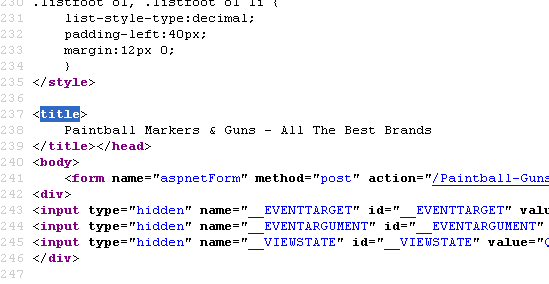 Does the location of the title tag, meta tags, and any structured data have any influence with respect to SEO and search engines? Put another way, could we benefit from moving the title tag up to the top?
I "surfed 'n surfed" and could not find any articles about this.
I would really appreciate any help on this as our site got decimated organically last May and we are looking for any help with SEO.
NIck
0
Does the location of the title tag, meta tags, and any structured data have any influence with respect to SEO and search engines? Put another way, could we benefit from moving the title tag up to the top?
I "surfed 'n surfed" and could not find any articles about this.
I would really appreciate any help on this as our site got decimated organically last May and we are looking for any help with SEO.
NIck
0 -

When creating parent and child pages should key words be repeated in url and page title?
We are in the direct mail advertising business: PrintLabelAndMail.com Example: Parent:
Technical SEO | | JimDirectMailCoach
Postcard Direct Mail Children:
Postcard Mailings
Postcard Design
Postcard Samples
Postcard Pricing
Postcard Advantages should "postcard" be repeated in the URL and Page Title? and in this example should each of the 5 children link back directly to the parent or would it be better to "daisy chain" them using each as parent for the next?0 -

Noindex vs. page removal - Panda recovery
I'm wondering whether there is a consensus within the SEO community as to whether noindexing pages vs. actually removing pages is different from Google Pandas perspective?Does noindexing pages have less value when removing poor quality content than physically removing ie. either 301ing or 404ing the page being removed and removing the links to it from the site? I presume that removing pages has a positive impact on the amount of link juice that gets to some of the remaining pages deeper into the site, but I also presume this doesn't have any direct impact on the Panda algorithm? Thanks very much in advance for your thoughts, and corrections on my assumptions 🙂
Technical SEO | | agencycentral0 -

Determining When to Break a Page Into Multiple Pages?
Suppose you have a page on your site that is a couple thousand words long. How would you determine when to split the page into two and are there any SEO advantages to doing this like being more focused on a specific topic. I noticed the Beginner's Guide to SEO is split into several pages, although it would concentrate the link juice if it was all on one page. Suppose you have a lot of comments. Is it better to move comments to a second page at a certain point? Sometimes the comments are not super focused on the topic of the page compared to the main text.
Technical SEO | | ProjectLabs1