Moz Q&A is closed.
After more than 13 years, and tens of thousands of questions, Moz Q&A closed on 12th December 2024. Whilst we’re not completely removing the content - many posts will still be possible to view - we have locked both new posts and new replies. More details here.
Are image pages considered 'thin' content pages?
-
I am currently doing a site audit. The total number of pages on the website are around 400... 187 of them are image pages and coming up as 'zero' word count in Screaming Frog report.
I needed to know if they will be considered 'thin' content by search engines? Should I include them as an issue?
An answer would be most appreciated.
-
Hmm I wasn't able to view that example with the URL you provided. What is the domain name?
-
Yes RangeMarketing... you are correct.
Here is an example:
-
Ohhhh my mistake, what you are describing sounds like image file locations rather than actual HTML pages, correct? Could you provide an example?
Thanks.
-
Hello guys,
One more point has just come up. I did a Copyscape search for content plaigiarism on the website and found that some pages (example the company overview page) has exact same content on multiple Linkedin domains (examples... sa.linked, tr.linked, ae.linkedin...)
does this matter?
-
Hello there....
Those 187 pages are image pages (or they may just be image files)... as in... nothing on the pages except an image only which is served on one of the site pages.
It does not bring any value to the user and actually doesn't even appear in analytics.
My gut feeling is that google would know this and will not take this as a negative signal. The images dont have a alt-attribute which I have noted and reported.
-
Don't know how feasible it is but could you include some sort of content within the page? Perhaps an introduction to what the images are?
As im not sure what the website is im not sure if this would work.
-
Hi there!
187 does seem quite high but it really comes down to the purpose of the pages. For some sites it might work, for others it won't. What type of website is it?
When doing a site / content audit I think it's important to understand what sort of value each page brings the user. You should consider looking at any analytics data you have for those pages to make a better judgement.
For example, if you find that the pages have a high bounce rate you might consider restructuring the pages or repurposing the image content for other areas of the website.
Hope this gets you thinking!





Got a burning SEO question?
Subscribe to Moz Pro to gain full access to Q&A, answer questions, and ask your own.
Browse Questions
Explore more categories
-
Moz Tools
Chat with the community about the Moz tools.
-
SEO Tactics
Discuss the SEO process with fellow marketers
-
Community
Discuss industry events, jobs, and news!
-
Digital Marketing
Chat about tactics outside of SEO
-
Research & Trends
Dive into research and trends in the search industry.
-
Support
Connect on product support and feature requests.
Related Questions
-

"Noindex, follow" for thin pages?
Hey there Mozzers, I have a question regarding Thin pages. Unfortunately, we have Thin pages, almost empty to be honest. I have the idea to ask the dev team to do "noindex, follow" on these pages. What do you think? Has someone faced this situation before? Will appreciate your input!
Technical SEO | | Europarl_SEO_Team0 -

Getting high priority issue for our xxx.com and xxx.com/home as duplicate pages and duplicate page titles can't seem to find anything that needs to be corrected, what might I be missing?
I am getting high priority issue for our xxx.com and xxx.com/home as reporting both duplicate pages and duplicate page titles on crawl results, I can't seem to find anything that needs to be corrected, what am I be missing? Has anyone else had a similar issue, how was it corrected?
Technical SEO | | tgwebmaster0 -

Should I disavow links from pages that don't exist any more
Hi. Im doing a backlinks audit to two sites, one with 48k and the other with 2M backlinks. Both are very old sites and both have tons of backlinks from old pages and websites that don't exist any more, but these backlinks still exist in the Majestic Historic index. I cleaned up the obvious useless links and passed the rest through Screaming Frog to check if those old pages/sites even exist. There are tons of link sending pages that return a 0, 301, 302, 307, 404 etc errors. Should I consider all of these pages as being bad backlinks and add them to the disavow file? Just a clarification, Im not talking about l301-ing a backlink to a new target page. Im talking about the origin page generating an error at ping eg: originpage.com/page-gone sends me a link to mysite.com/product1. Screamingfrog pings originpage.com/page-gone, and returns a Status error. Do I add the originpage.com/page-gone in the disavow file or not? Hope Im making sense 🙂
Technical SEO | | IgorMateski0 -

Does Title Tag location in a page's source code matter?
Currently our meta description is on line 8 for our page - http://www.paintball-online.com/Paintball-Guns-And-Markers-0Y.aspx
Technical SEO | | Istoresinc The title tag, however sits below a bunch of code on line 237
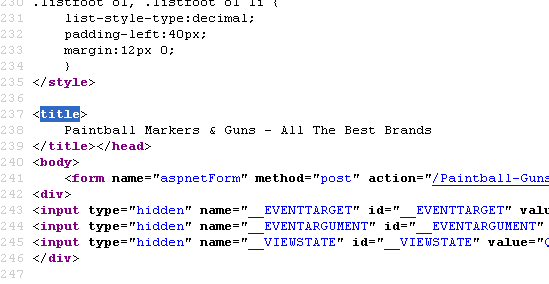 Does the location of the title tag, meta tags, and any structured data have any influence with respect to SEO and search engines? Put another way, could we benefit from moving the title tag up to the top?
I "surfed 'n surfed" and could not find any articles about this.
I would really appreciate any help on this as our site got decimated organically last May and we are looking for any help with SEO.
NIck
0
Does the location of the title tag, meta tags, and any structured data have any influence with respect to SEO and search engines? Put another way, could we benefit from moving the title tag up to the top?
I "surfed 'n surfed" and could not find any articles about this.
I would really appreciate any help on this as our site got decimated organically last May and we are looking for any help with SEO.
NIck
0 -

Duplicate content on Product pages for different product variations.
I have multiple colors of the same product, but as a result I'm getting duplicate content warnings. I want to keep these all different products with their own pages, so that the color can be easily identified by browsing the category page. Any suggestions?
Technical SEO | | bobjohn10 -

How Does Google's "index" find the location of pages in the "page directory" to return?
This is my understanding of how Google's search works, and I am unsure about one thing in specific: Google continuously crawls websites and stores each page it finds (let's call it "page directory") Google's "page directory" is a cache so it isn't the "live" version of the page Google has separate storage called "the index" which contains all the keywords searched. These keywords in "the index" point to the pages in the "page directory" that contain the same keywords. When someone searches a keyword, that keyword is accessed in the "index" and returns all relevant pages in the "page directory" These returned pages are given ranks based on the algorithm The one part I'm unsure of is how Google's "index" knows the location of relevant pages in the "page directory". The keyword entries in the "index" point to the "page directory" somehow. I'm thinking each page has a url in the "page directory", and the entries in the "index" contain these urls. Since Google's "page directory" is a cache, would the urls be the same as the live website (and would the keywords in the "index" point to these urls)? For example if webpage is found at wwww.website.com/page1, would the "page directory" store this page under that url in Google's cache? The reason I want to discuss this is to know the effects of changing a pages url by understanding how the search process works better.
Technical SEO | | reidsteven750 -

Determining When to Break a Page Into Multiple Pages?
Suppose you have a page on your site that is a couple thousand words long. How would you determine when to split the page into two and are there any SEO advantages to doing this like being more focused on a specific topic. I noticed the Beginner's Guide to SEO is split into several pages, although it would concentrate the link juice if it was all on one page. Suppose you have a lot of comments. Is it better to move comments to a second page at a certain point? Sometimes the comments are not super focused on the topic of the page compared to the main text.
Technical SEO | | ProjectLabs1 -

Can I format my H1 to be smaller than H2's and H3's on the same page?
I would like to create a web design with 12px H1 and for sub headings on the page to be more like 24px. Will search engines see this and dislike it? The reason for doing it is that I want to put a generic page title in the banner, and more poetic headings above the main body. Example: Small H1: Wholesale coffee, online coffee shop and London roastery Large h2: Respect the bean... Thanks
Technical SEO | | Crumpled_Dog
Scott0