Moz Q&A is closed.
After more than 13 years, and tens of thousands of questions, Moz Q&A closed on 12th December 2024. Whilst we’re not completely removing the content - many posts will still be possible to view - we have locked both new posts and new replies. More details here.
Title Tag vs. H1 / H2
-
OK, Title tag, no problem, it's the SEO juice, appears on SERP, etc. Got it.
But I'm reading up on H1 and getting conflicting bits of information ...
- Only use H1 once?
- H1 is crucial for SERP
- Use H1s for subheads
- Google almost never looks past H2 for relevance
So say I've got a blog post with three sections ... do I use H1 three times (or does Google think you're playing them ...)
Or do I create a "big" H1 subhead and then use H2s? Or just use all H2s because H1s are scary?

I frequently use subheads, it would seem weird to me to have one a font size bigger than another, but of course I can adjust that in settings ...
Thoughts?
Lisa
-
Let me add that
- In many cases the title tag will also contain the website's name, as in
<title>Awesome Cool Headline | website name<title></li> <li>A good CMS will let you differentiate between headline in title and headline on the page (the H1)</li> <li>If your website is indexed by Google News the shown headline will be the H1, not the title tag</li> </ul></title>
- In many cases the title tag will also contain the website's name, as in
-
<title>Awesome Cool Headline<title></p> <p><H1>Awesome Cool Headline<H1></p> <p>This looks correct. Then use H2 for subheadings. The title won't get printed on the page so "Awesome Cool Headline" will only show once on the page content.</p></title>
-
OK, getting more information ... I think the issue here is this is for a blog and I'm thinking the Title tag usurps the H1.
For a blog, it would be:
<title>Awesome Cool Headline<title></p> <p><H1>Awesome Cool Headline<H1></p> <p>which would look redundant. So I think I could use the first subhead as an H1 if it was written in a way that was relevant to the story, but I'm guessing best practices are H2. Although if I did that, I'd NEVER have an H1 on my pages unless I was doing a landing page promotion of some sort ... hmmm.</p></title>
-
Ah, so ...
- Title (duh)
- H1 header (use as first subhead after lead graph to set the tone for the piece?)
- H2 for all other subheads
- Set H1 and H2 at the same font style so no one knows the difference.
Can someone give me a good example of an H1? I don't know why I'm a bit stuck on the H1 application, but a few in the wild examples should help. This is truly appreciated guys!
Thanks!
-
Like others have mentioned you should only have one H1. This should appear on the page before any other headings such as h2, h3 etc.
The styling shouldn't matter so the h1 doesn't need to be in a larger font size than the h2's.
-
Of the 4 points you mention you've seen, I'd say the only one that's entirely incorrect is #3.
1. Only use H1 once: True. Think of it like a book title. That's the most important thing, so nothing else should share that prominence.
2. H1 is crucial for SERP: **True. **This is what Google looks to, after your title tag, for information about your page and the content therein. This reaffirms that your metadata, keywords, title, content, etc. are all related - while also showing visitors what this page is about (Google values visitor experience more and more with each update).
3. Use H1s for subheads. False. Think back to #1 - H1 should be reserved only for the 1 absolute most important thing (which should be your title).
4. Google almost never looks past H2 for relevance. Kind of true. Google DOES look beyond this (and even parses your body-text), but with each lowering of prominence / heading, Google gives it less weight. #4 is true in the sense that this weight is lessened significantly, but it's incorrect generally - your content is still very important.
I hope this has been helpful to you! Good luck!
-
Just use H1 one time, matt cutts said in a video that he would like to see only 1 H1 tag on a page.
Create content for better user experience, use headings just for your readers, and don't follow these on page tactics very much. Now everyone knows these techniques, and I don't think Google gives higher weight to these things.
Create content for readers
Use H1 as your Page's Heading(Just one time)
Use H2 where you think it's essential





Got a burning SEO question?
Subscribe to Moz Pro to gain full access to Q&A, answer questions, and ask your own.
Browse Questions
Explore more categories
-
Moz Tools
Chat with the community about the Moz tools.
-
SEO Tactics
Discuss the SEO process with fellow marketers
-
Community
Discuss industry events, jobs, and news!
-
Digital Marketing
Chat about tactics outside of SEO
-
Research & Trends
Dive into research and trends in the search industry.
-
Support
Connect on product support and feature requests.
Related Questions
-

Exact Match Domain & Title Tag / URL
I currently own an exact match domain for my keyword. I have it set up with multiple pages and also a blog. The home page essentially serves as a hub and contains links to all the pages and the blog. My targeted keyword is on its own page and I made the title tag the same as my keyword. As an example the URL for my targeted post looks like this: benefitsofrunningshoes.com/benefits-of-running-shoes I have solid, non-spammy content and clean whitehat earned backlinks directing to that specific page. My concern right now is that the URL looks kinda spammy. The website has been live for about a week and the home page ranks well enough but my targeted page is no where to be found. (it does show up if I manually search via search command "site:benefitsofrunningshoes.com"). I'm wondering if it is acceptable to use the exact keyword in title tag / page url if it is also in the domain as an EMD? Should I change the title tag and leave the URL in? Or should I completely change the title tag and URL and 301 redirect to the new page? I appreciate any help!
Technical SEO | | Kusanagi170 -

Does Title Tag location in a page's source code matter?
Currently our meta description is on line 8 for our page - http://www.paintball-online.com/Paintball-Guns-And-Markers-0Y.aspx
Technical SEO | | Istoresinc The title tag, however sits below a bunch of code on line 237
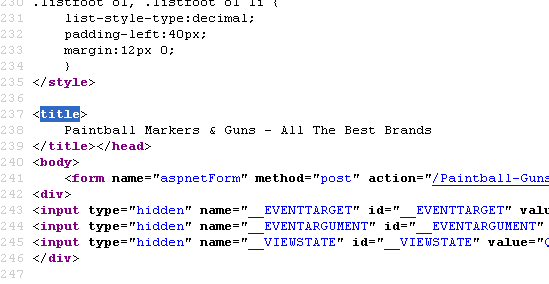 Does the location of the title tag, meta tags, and any structured data have any influence with respect to SEO and search engines? Put another way, could we benefit from moving the title tag up to the top?
I "surfed 'n surfed" and could not find any articles about this.
I would really appreciate any help on this as our site got decimated organically last May and we are looking for any help with SEO.
NIck
0
Does the location of the title tag, meta tags, and any structured data have any influence with respect to SEO and search engines? Put another way, could we benefit from moving the title tag up to the top?
I "surfed 'n surfed" and could not find any articles about this.
I would really appreciate any help on this as our site got decimated organically last May and we are looking for any help with SEO.
NIck
0 -

Multiple H1 tags in Squarespace
Hi. I'm using Squarespace, and I've noticed they assign the page title and site title h1 tag status. So if I add an on-page h1 tag, that's three in total. I've seen what Matt Cutts said about multiple h1 tags being acceptable (although that video was back in 2009 and a lot has changed since then). But I'm still a little concerned that this is perhaps not the best way of structuring for SEO. Could anyone offer me any advice? Thanks.
Technical SEO | | The_Word_Department0 -

Div tags vs. Tables
Is there any reason NOT to code in tables (other than it being outdated) for SEO reasons?
Technical SEO | | EileenCleary0 -

/~username
Hello, The utility on this site that crawls your site and highlights what it sees as potential problems reported an issue with /~username access seeing it as duplicate content i.e. mydomain.com/file.htm is the same as mydomain.com~/username/file.htm so I went to my server hosts and they disabled it using mod_userdir but GWT now gives loads of 404 errors. Have I gone about this the wrong way or was it not really a problem in the first place or have I fixed something that wasn't broken and made things worse? Thanks, Ian
Technical SEO | | jwdl0 -

Duplicate Title Tag issue due to Shopify CMS
Hi guys, I'm a novice really when it comes to SEO, yet have taken it in house for the next year or so, firstly because I have had my fingers burnt twice...and secondly, to allow me to recoup some of the loss from my prior campaigns. One thing I have noticed on my site (which uses a Shopify E-commerce CMS), is that Shopify duplicates a url for each my products. An example of this is http://www.vidahomes.co.uk/collections/designer-radiators-heating/products/reina-aliano
Technical SEO | | philscott2006
http://www.vidahomes.co.uk/products/reina-aliano Both products provide exactly the same information, yet appear in different ways subject to how the customer finds them. I contacted Shopify to find a fix to this issue when I noticed a high amount of Duplicate Title Tags in my SEO crawl. Their response was as follows. Using a rel canonical link will help prevent duplicate content issues with search engines. All you need to do is add this line of code: **<link rel="canonical" href="{{ canonical_url }}" />** ** before the tag in the theme.liquid file. It’s that simple :)** The theme liquid file basically generates the outer template for the whole site, and is only compromised when over-ruled. This all seems a little too easy for me, so I am hoping whether someone can elaborate as to whether this will work or not, as I'm not entirely sold on their response. I was always under the impression with canonical tags, that they should be added to the header section of the duplicate page in question, which refers back to the original page. The code I have been told to add above implies that the canonical tag would be added to every page in my site so the Google robot would have a hard time in finding anything at all of relevance Thanks in advance for any assistance with this. Kind Regards Phil Scott Vida Homes0 -

How many strong tags is too many
Hi everyone, just a quick question, what are your views on the use of strong tags in content? how many is too many? What is you have strong tags around every keywords for a sentance etc?
Technical SEO | | pauledwards1 -

Use of Meta Tag - MSSmartTagsPreventParsing
We've inherited some sites from another developer that had the following tag: All references I can find to it are from 2004. What is the purpose and is it worth including in pages/sites we build?
Technical SEO | | wcksmith0