Moz Q&A is closed.
After more than 13 years, and tens of thousands of questions, Moz Q&A closed on 12th December 2024. Whilst we’re not completely removing the content - many posts will still be possible to view - we have locked both new posts and new replies. More details here.
Ecommerce website: Product page setup & SKU's
-
I manage an E-commerce website and we are looking to make some changes to our product pages to try and optimise them for search purposes and to try and improve the customer buying experience.
This is where my head starts to hurt!
Now, let's say I am selling a T shirt that comes in 4 sizes and 6 different colours. At the moment my website would have 24 products, each with pretty much the same content (maybe differing references to the colour & size).
My idea is to change this and have 1 main product page for the T-shirt, but to have 24 product SKU's/variations that exist to give the exact product details. Some different ways I have been considering to do this:
a) have drop-down fields on the product page that ask the customer to select their Tshirt size and colour. The image & price then changes on the page.
b) All product 24 product SKUs sre listed under the main product with the 'Add to Cart' open next to each one. Each one would be clickable so a page it its own right.
Would I need to set up a canonical links for each SKU that point to the top level product page?
I'm obviously looking to minimise duplicate content but Im not exactly sure on how to set this up - its a big decision so I need to be 100% clear before signing off on anything. .
Any other tips on how to do this or examples of good e-commerce websites that use product SKus well?
Kind regards
Tom
-
Ah cool!
 I am glad it has worked out.
 -
Thanks Istvan.
I've just spoken to Google help via their online Adwords Chat function (good tip there!) and they have provided me with information about setting up your products so that the SKUs are displayed depending on the terms the searcher uses:
http://support.google.com/merchants/bin/answer.py?hl=en&answer=188494#other
For reference, you basically tag your 1 product page up and tell in the data feed within Google Merchant - this will in turn tell Google which variant URL to show to the browser based on things such as size, colour, weight etc. et.c
-
I am not 100% sure, but I think with this case you could only use the product page itself.
I need to digg into this a littlebit more before giving you an accurate answer.
-
1 follow up question....do you know how this would work with regards to Google Shopping / Base?
If I followed the approach you have suggested would I be able to add each SKU as an individual item within Google shopping (ie. large red t-shirt, medium red t-shirt, yellow medium t-shirt etc.) or would I only be able to promote the product page itself (containing all 24 SKUs - for example)?
-
Ok great - thanks for the great advice!
-
Hi Tom,
I would only change the picture and the price (if applicable). The text could also change is some proportion (for example the size description, color description, etc).
Gr.,
Istvan
-
Thanks Istvan - so what would the customer be looking at when they view the SKU URL?
Is the image & text completely different or would you just change the picture & price (if applicable)...hope my question makes sense!
-
Hi Tom,
What I would do is that I would use the same url and different parameter for the SKU-s.
I will point out an example:
www.example.com/cat/t-shirt.html?sku=skunumber
on the product page you would have a canonical link to: www.example.com/cat/t-shirt.html
I hope that helped,
Istvan


Got a burning SEO question?
Subscribe to Moz Pro to gain full access to Q&A, answer questions, and ask your own.
Browse Questions
Explore more categories
-
Moz Tools
Chat with the community about the Moz tools.
-
SEO Tactics
Discuss the SEO process with fellow marketers
-
Community
Discuss industry events, jobs, and news!
-
Digital Marketing
Chat about tactics outside of SEO
-
Research & Trends
Dive into research and trends in the search industry.
-
Support
Connect on product support and feature requests.
Related Questions
-

Does anyone know the linking of hashtags on Wix sites does it negatively or postively impact SEO. It is coming up as an error in site crawls 'Pages with 404 errors' Anyone got any experience please?
Does anyone know the linking of hashtags on Wix sites does it negatively or positively impact SEO. It is coming up as an error in site crawls 'Pages with 404 errors' Anyone got any experience please? For example at the bottom of this blog post https://www.poppyandperle.com/post/face-painting-a-global-language the hashtags are linked, but they don't go to a page, they go to search results of all other blogs using that hashtag. Seems a bit of a strange approach to me.
Technical SEO | | Mediaholix0 -

Product schema GSC Error 'offers, review, or aggregateRating should be specified'
I do not have a sku, global identifier, rating or offer for my product. Nonetheless it is my product. The price is variable (as it's insurance) so it would be inappropriate to provide a high or low price. Therefore, these items were not included in my product schema. SD Testing tool showed 2 warnings, for missing sku and global identifier. Google Search Console gave me an error today that said: 'offers, review, or aggregateRating should be specified' I don't want to be dishonest in supplying any of these, but I also don't want to have my page deprecated in the search results. BUT I DO want my item to show up as a product. Should I forget the product schema? Advice/suggestions? Thanks in advance.
Technical SEO | | RoxBrock1 -

Product meta tags are not updating in my Magneto website!
I need some help! For some reason, each time I update the product meta tags in my Magento website, it doesn't change on the current website? Could someone help me understand why that is?
Technical SEO | | One2OneDigital0 -

Does Title Tag location in a page's source code matter?
Currently our meta description is on line 8 for our page - http://www.paintball-online.com/Paintball-Guns-And-Markers-0Y.aspx
Technical SEO | | Istoresinc The title tag, however sits below a bunch of code on line 237
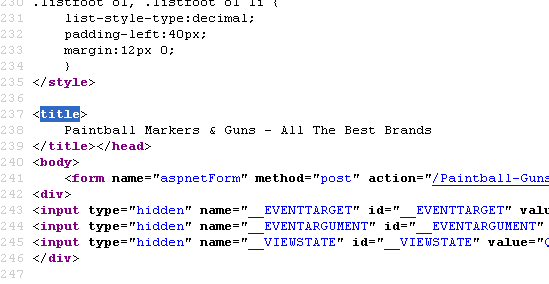 Does the location of the title tag, meta tags, and any structured data have any influence with respect to SEO and search engines? Put another way, could we benefit from moving the title tag up to the top?
I "surfed 'n surfed" and could not find any articles about this.
I would really appreciate any help on this as our site got decimated organically last May and we are looking for any help with SEO.
NIck
0
Does the location of the title tag, meta tags, and any structured data have any influence with respect to SEO and search engines? Put another way, could we benefit from moving the title tag up to the top?
I "surfed 'n surfed" and could not find any articles about this.
I would really appreciate any help on this as our site got decimated organically last May and we are looking for any help with SEO.
NIck
0 -

Is there a way for me to automatically download a website's sitemap.xml every month?
From now on we want to store all our sitemap.xml over the next years. Its a nice archive to have that allows us to analyse how many pages we have on our website and which ones were removed/redirected. Any suggestions? Thanks
Technical SEO | | DeptAgency0 -

How Does Google's "index" find the location of pages in the "page directory" to return?
This is my understanding of how Google's search works, and I am unsure about one thing in specific: Google continuously crawls websites and stores each page it finds (let's call it "page directory") Google's "page directory" is a cache so it isn't the "live" version of the page Google has separate storage called "the index" which contains all the keywords searched. These keywords in "the index" point to the pages in the "page directory" that contain the same keywords. When someone searches a keyword, that keyword is accessed in the "index" and returns all relevant pages in the "page directory" These returned pages are given ranks based on the algorithm The one part I'm unsure of is how Google's "index" knows the location of relevant pages in the "page directory". The keyword entries in the "index" point to the "page directory" somehow. I'm thinking each page has a url in the "page directory", and the entries in the "index" contain these urls. Since Google's "page directory" is a cache, would the urls be the same as the live website (and would the keywords in the "index" point to these urls)? For example if webpage is found at wwww.website.com/page1, would the "page directory" store this page under that url in Google's cache? The reason I want to discuss this is to know the effects of changing a pages url by understanding how the search process works better.
Technical SEO | | reidsteven750 -

Blog Ranking NOT home page main website?!
Hi, Our Blog (http://blog.thailand-investigation.com) is ranking for some of our major keywords but not our home page (http://www.thailand-investigation.com)!? Our blog is WordPress and our main website is HTML. It seems like the search engines consider that they are 2 separate websites!? When I check the incoming links to our website, I get also the blog links!!!??? Is it normal? Do I have to build a relation of some kind or write some code saying that it is our Blog... I don't know! I'm not a SEO specialist or even a webmaster. I'm a small business owner and take care on my website. I created by myself but never learned! So, please help! Thanks
Technical SEO | | MichelMauquoi0 -

Adding 'NoIndex Meta' to Prestashop Module & Search pages.
Hi Looking for a fix for the PrestaShop platform Look for the definitive answer on how to best stop the indexing of PrestaShop modules such as "send to a friend", "Best Sellers" and site search pages. We want to be able to add a meta noindex ()to pages ending in: /search?tag=ball&p=15 or /modules/sendtoafriend/sendtoafriend-form.php We already have in the robot text: Disallow: /search.php
Technical SEO | | reallyitsme
Disallow: /modules/ (Google seems to ignore these) But as a further tool we would like to incude the noindex to all these pages too to stop duplicated pages. I assume this needs to be in either the head.tpl or the .php file of each PrestaShop module.? Or is there a general site wide code fix to put in the metadata to apply' Noindex Meta' to certain files. Current meta code here: Please reply with where to add code and what the code should be. Thanks in advance.0