Moz Q&A is closed.
After more than 13 years, and tens of thousands of questions, Moz Q&A closed on 12th December 2024. Whilst we’re not completely removing the content - many posts will still be possible to view - we have locked both new posts and new replies. More details here.
Structuring URL's for better SEO
-
Hello,
We were rolling our fresh urls for our new service website.
Currently we have our structure as www.practo.com/health/dental/clinic/bangalore
We like to have it as www.practo.com/health/dental-clinic-bangalore
Can someone advice us better which one of the above structure would work out better and why?
Should this be a focus of attention while going ahead since this is like a search engine platform for patients looking out for actual doctors.
Thanks,
Aditya
-
Your next route would be to set up a Google Places for your location so that you return in the local searches for where you are based. So when the search term 'Dental Clinic Bangalore' is searched for your website will appear.
After that for specific regions, have different pages on your site such as www.practo.com/health/dental-clinic-jayangar.
This means that the page name is dental-clinic-jayangar as opposed to www.practo.com/health/dental/clinic/jayangar where the site structure leads to a page name of just jayangar.If the page name is the search term, you stand in a lot better for ranking in the SERP.
-
Thanks.
We would have specific urls for eg: www.practo.com/health/dental-clinic-jayangar
So Jayanagar becomes our Locality specific to Bangalore and then a Dental Clinic becomes a widely searched key term on the SERP.
You are also suggesting to base urls on local key terms searches? Say dental clinic koramangala has a good key term search result from the keyword tool - so here we could base our urls as /dental-clinic-koramangala?
Why not practo.com/health/dental/clinic/koramangala - is this an un-appropriate way of going about url structuring?
-
Hi,
Firstly you have to figure out which search time you want to be found for. Having bangalore as a page name in the first instance would not be focused enough at all. You need to refine this keyword.
The second URL structure would present your search term as 'dental clinic bangalore' and would be much more focused and refined. There are local searches in India for that key term according to Google Keyword Tool so that would definitely be the way to go forward.
Make sure that you set up 301 redirects from the old URL structure to the new URL structure to maintain any link juice and you will be on your way. For a redirect I would typically give it a month until the 301 redirect starts passing through the old page authority.
Good luck.


Got a burning SEO question?
Subscribe to Moz Pro to gain full access to Q&A, answer questions, and ask your own.
Browse Questions
Explore more categories
-
Moz Tools
Chat with the community about the Moz tools.
-
SEO Tactics
Discuss the SEO process with fellow marketers
-
Community
Discuss industry events, jobs, and news!
-
Digital Marketing
Chat about tactics outside of SEO
-
Research & Trends
Dive into research and trends in the search industry.
-
Support
Connect on product support and feature requests.
Related Questions
-

Does anyone know the linking of hashtags on Wix sites does it negatively or postively impact SEO. It is coming up as an error in site crawls 'Pages with 404 errors' Anyone got any experience please?
Does anyone know the linking of hashtags on Wix sites does it negatively or positively impact SEO. It is coming up as an error in site crawls 'Pages with 404 errors' Anyone got any experience please? For example at the bottom of this blog post https://www.poppyandperle.com/post/face-painting-a-global-language the hashtags are linked, but they don't go to a page, they go to search results of all other blogs using that hashtag. Seems a bit of a strange approach to me.
Technical SEO | | Mediaholix0 -

Japanese URL-structured sitemap (pages) not being indexed by Bing Webmaster Tools
Hello everyone, I am facing an issue with the sitemap submission feature in Bing Webmaster Tools for a Japanese language subdirectory domain project. Just to outline the key points: The website is based on a subdirectory URL ( example.com/ja/ ) The Japanese URLs (when pages are published in WordPress) are not being encoded. They are entered in pure Kanji. Google Webmaster Tools, for instance, has no issues reading and indexing the page's URLs in its sitemap submission area (all pages are being indexed). When it comes to Bing Webmaster Tools it's a different story, though. Basically, after the sitemap has been submitted ( example.com/ja/sitemap.xml ), it does report an error that it failed to download this part of the sitemap: "page-sitemap.xml" (basically the sitemap featuring all the sites pages). That means that no URLs have been submitted to Bing either. My apprehension is that Bing Webmaster Tools does not understand the Japanese URLs (or the Kanji for that matter). Therefore, I generally wonder what the correct way is to go on about this. When viewing the sitemap ( example.com/ja/page-sitemap.xml ) in a web browser, though, the Japanese URL's characters are already displayed as encoded. I am not sure if submitting the Kanji style URLs separately is a solution. In Bing Webmaster Tools this can only be done on the root domain level ( example.com ). However, surely there must be a way to make Bing's sitemap submission understand Japanese style sitemaps? Many thanks everyone for any advice!
Technical SEO | | Hermski0 -

SERP result (URL) doesn't change after a 301
A couple of months ago there was a result in Google for our branded search term which wasn't the 'official' URL, actually the result shown in the SERP was www.mycompany-ip.nl. We've applied a 301 redirect of this URL to the 'official' URL which is a subdomain: department.mycompany.nl. From Google the redirect is obviously working, but up until now, I don't see Google replacing the incorrect URL by the correct URL. I am wondering what to do to make the result correct. André
Technical SEO | | ConclusionDigital0 -

Category URL Pagination where URLs don't change between pages
Hello, I am working on an e-commerce site where there are categories with multiple pages. In order to avoid pagination issues I was thinking of using rel=next and rel=prev and cannonical tags. I noticed a site where the URL doesn't change between pages, so whether you're on page 1,2, or 3 of the same category, the URL doesn't change. Would this be a cleaner way of dealing with pagination?
Technical SEO | | whiteonlySEO0 -

Strange URL's for client's site
We just picked up a new client and I've been doing some digging around on their site. They have quite the wide variety of URL's that make for a rather confusing experience. One of the milder examples is their "About" page. Normally I would expect something along the lines of: www.website.com/about I see: www.website.com/default.asp?Page=About I'm typically a graphic designer and know basically nothing about code, but I just assume this has something funky to do with how their website was constructed. I'm assuming this isn't particularly SEO friendly, but it doesn't seem too bad. Until I got to another section of their site. It's a section that logically should look like: www.website.com/training/public-seminars It's: www.website.com/default.asp?Page=MT&Area=Seminars&Sub=MRM Now that's nonsensical to me! Normally if a client has terrible URL's, I'd say let's do some redirects, but I guess I'm a little intimidated by these. Do the URL's have to be structured like this for some reason? Am I missing some important area of coding here? However, the most bizarre example is a link back to their website from yellowpages.com. Where normally I would expect it to lead to their homepage, I get this bizarre-looking thing: http://website1-px.rtrk.com/?utm_source=ReachLocal&utm_medium=PPC&utm_campaign=AssetManagement&reference_id=15&publisher=yellowpages&placement=ypwebsitemip&action_target=listing_website And as you browse through the site, that strange domain stays. For example the About page is now: http://website1-px.rtrk.com/default.asp?Page=About I would try to google this but I have no idea where to even start! What is going on with these links? Will we be able to fix them to something presentable without breaking their website?
Technical SEO | | everestagency0 -

SEO impact of the anatomy of URL subdirectory structure?
I've been pushing hard to get our Americas site (DA 34) integrated with our higher domain authority (DA 51) international website. Currently our international website is setup in the following format... website.com/us-en/ website.com/fr-fr/ etc... The problem that I am facing is that I need my development framework installed in it's own directory. It cannot be at the root of the website (website.com) since that is where the other websites (us-en, fr-fr, etc.) are being generated from. Though we will have control of /us-en/ after the integration I cannot use that as the website main directory since the americas website is going to be designed for scalability (eventually adopting all regions and languages) so it cannot be region specific. What we're looking at is website.com/[base]/us-en. I'm afraid that if base has any length to it in terms of characters it is going to dilute the SEO value of whatever comes after it in the URL (website.com/[base]/us-en/store/product-name.html). Any recommendations?
Technical SEO | | bearpaw0 -

Does Title Tag location in a page's source code matter?
Currently our meta description is on line 8 for our page - http://www.paintball-online.com/Paintball-Guns-And-Markers-0Y.aspx
Technical SEO | | Istoresinc The title tag, however sits below a bunch of code on line 237
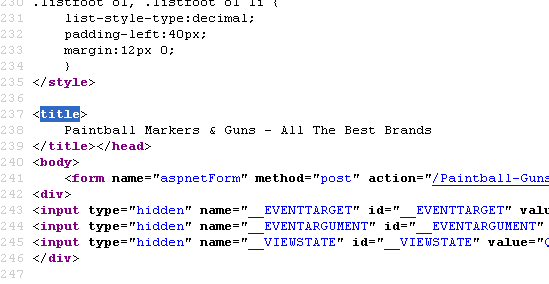 Does the location of the title tag, meta tags, and any structured data have any influence with respect to SEO and search engines? Put another way, could we benefit from moving the title tag up to the top?
I "surfed 'n surfed" and could not find any articles about this.
I would really appreciate any help on this as our site got decimated organically last May and we are looking for any help with SEO.
NIck
0
Does the location of the title tag, meta tags, and any structured data have any influence with respect to SEO and search engines? Put another way, could we benefit from moving the title tag up to the top?
I "surfed 'n surfed" and could not find any articles about this.
I would really appreciate any help on this as our site got decimated organically last May and we are looking for any help with SEO.
NIck
0 -

Landing Page URL Structure
We are finally setting up landing pages to support our PPC campaigns. There has been some debate internally about the URL structure. Originally we were planning on URL's like: domain.com /california /florida /ny I would prefer to have the URL's for each state inside a "state" folder like: domain.com /state /california /florida /ny I like having the folders and pages for each state under a parent folder to keep the root folder as clean as possible. Having a folder or file for each state in the root will be very messy. Before you scream URL rewriting :-). Our current site is still running under Classic ASP which doesn't support URL rewriting. We have tried to use HeliconTech's ISAPI rewrite module for IIS but had to remove it because of too many configuration issues. Next year when our coding to MVC is complete we will use URL rewriting. So the question for now: Is there any advantage or disadvantage to one URL structure over the other?
Technical SEO | | briankb0